DUSHANBE, May 12, 2016, Asia-Plus — The Central Asia South Asia Electricity Transmission and Trade (Casa-1000) Project has been by officials from Afghanistan, Pakistan, Tajikistan, and Kyrgyzstan.
The project was unveiled in a ceremony in the Tajik city of Tursunzoda, 60 kilometers to the west of Dushanbe on May 12.
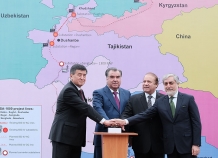
Afghan Chief Executive Abdullah Abdullah, Pakistani Prime Minister Nawaz Sharif, Tajik President Emomali Rahmon, and Kyrgyz Prime Minister Sooronbay Jeenbekov attended the opening ceremony.
On the occasion, they were briefed about the project.
Tajik President Emomali Rahmon, in particular, noted that the ceremony of inauguration of the project is a symbol of practical cooperation between the countries of Central Asia and South Asia.
Emomali Rahmon noted that the main sources of financing the project had been determined. He appreciated support of the World Bank, the European Bank for Reconstruction and Development, the Islamic Development Bank, the European Investment Bank, the United States Agency for International Development and the British Department for International Development.
Tajikistan and Kyrgyzstan are expected to annually supply up to 5 billion kWh of electricity to Afghanistan and Pakistan via this power transmission line.
“This will promote solution of a number of social, economic and environmental protection problems in all the four countries,” Tajik president said.
Kyrgyz Prime Minister Sooronbay Jeenbekov, for his part, noted that the project would improve living conditions in the region.
Afghan Chief Executive Abdullah Abdullah noted that “the project that was just a dream ten years ago is being put into practice today.”
Speaking at the ground breaking ceremony, Pakistani Prime Minister Nawaz Sharif said it is an important project in the region connecting Central Asia, Afghanistan and South Asia through electricity grid.
According to The Nation (Pakistan), he said for many years of its conception, they were entering implementation stage.
The Prime Minister said this creates a win win situation for all stakeholders. This project will bring a number of economic and environment benefits and reduce energy deficit, improve trade and business links besides promoting friendship among participating countries.
Nawaz Sharif said the project brings landmark cooperation among the four countries and it isn important step for realization of plan to South Asia and Central Asia electricity market.
Nawaz Sharif emphasized that connectivity is key to regional integration, economic and trade development as well as people to people contacts.
He appreciated for the tremendous efforts by President Emomali Rahmon and his team for the accomplishment of CASA 1000.
World Bank Vice President for South Asia region Annette Dixon in her speech congratulated the four countries for achieving this significant milestone, The Nation reports. She said the World Bank is happy that South Asian and Central Asian countries are demonstrating for cooperation and regional electricity market. She said the CASA1000 will ease electricity shortage for Pakistan and Afghanistan during summer when the demand is higher and reduce dependence on costly oil power generation.
She said another benefit of CASA 1000 that will establish Afghanistan as a viable transit country for electricity and later for other exchanges. She said it is a challenging project because four countries across two regions have to work together. She said the economic gains from the project could contribute to peace and stability and ensure energy security of the region. She said CASA is not with challenges but it is achievable as we see today.
The CASA 1000 project is scheduled to be completed in 2020. The total cost of the project amounts to more than $1 billion.
The Project is expected to develop the necessary physical infrastructure and create the institutional and legal framework to transmit surplus power available from existing generation facilities in Tajikistan and Kyrgyzstan to Afghanistan and Pakistan. The physical infrastructure for CASA 1000 is likely to include: a 500 kV high voltage direct current (HVDC) transmission system between Tajikistan and Pakistan through Afghanistan; an AC transmission link from Kyrgyzstan and Tajikistan to connect to the HVDC line from Tajikistan to South Asia; and the necessary electricity sub-stations in Kabul, Peshawar and Sangtuda (in Tajikistan).