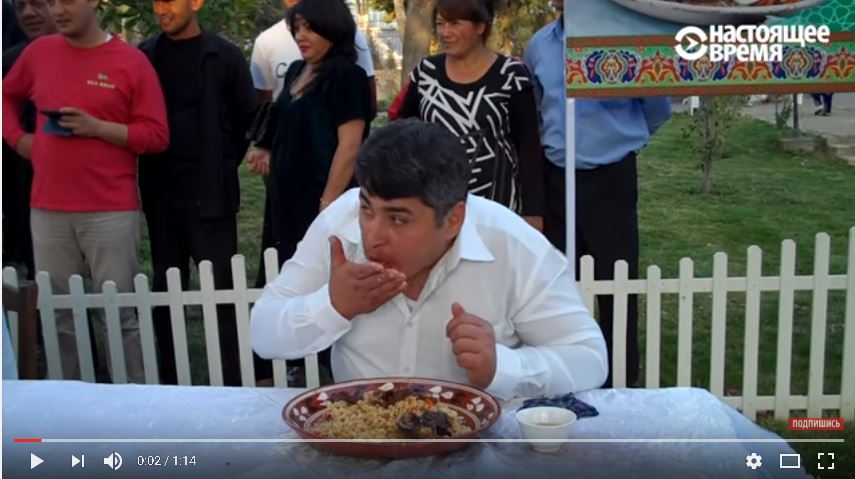
A pilaf-eating competition has taken place at an open-air festival in Khujand, the capital of northern Sughd province.
Fifteen heavyweights have taken place in the completion and the winner has received 2,000 somoni in money prize.
“I would have eaten more but time has been over,” the winner said.
Pilaf is a dish in which rice is cooked in a seasoned broth. In some cases, the rice may also attain its brown color by being stirred with pieces of cooked onion, as well as a mix of spices. Depending on the local cuisine, it may also contain meat, fish, vegetables, pasta, and dried fruits.
Pilaf and similar dishes are common to Balkan, Middle Eastern, Caucasian, Central and South Asian, East African, Latin American and Caribbean cuisines. It is a staple food and a national dish in Afghan, Armenian, Azerbaijani, Bangladeshi, Balochi, Bukharan Jewish, Cretan, Indian, Iranian, Kazakh, Kyrgyz, Kurdish, Pakistani, Uyghur, Uzbek, Tajik and Turkish cuisines.
Central Asian, e.g. Tajik and Uzbek pilaf differs from other preparations in that rice is not steamed, but instead simmered in a rich stew of meat and vegetables called zirbak, until all the liquid is absorbed into the rice. A limited degree of steaming is commonly achieved by covering the pot. It is usually cooked in a deg (a type of large cooking pot used throughout Central) over an open fire. The cooking tradition includes many regional and occasional variations. Commonly, it is prepared with lamb, browned in lamb fat or oil, and then stewed with fried onions, garlic and carrots. Chicken pilaf is rare but found in traditional recipes originating in Bukhara. Pilaf is usually spiced with whole black cumin, coriander, barberries, red pepper, marigold, and pepper. Heads of garlic and garbanzo beans are buried into the rice during cooking. Sweet variations with dried apricots, cranberries and raisins are prepared on special occasions.