Pilaf-eating completion takes place in Khujand

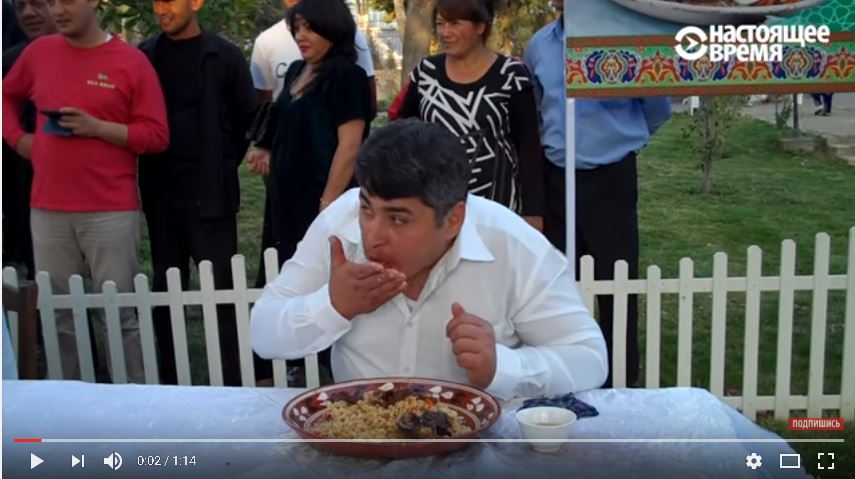
A pilaf-eating competition has taken place at an open-air festival in Khujand, the capital of northern Sughd province. Fifteen heavyweights have taken place in the completion and the winner has received 2,000 somoni in money prize.  “I would have eaten more but time has been over,” the winner said. Pilaf is a dish in which […]

Asia-Plus

A pilaf-eating competition has taken place at an open-air festival in Khujand, the capital of northern Sughd province.

Fifteen heavyweights have taken place in the completion and the winner has received 2,000 somoni in money prize. 

“I would have eaten more but time has been over,” the winner said.

Pilaf is a dish in which rice is cooked in a seasoned broth.  In some cases, the rice may also attain its brown color by being stirred with pieces of cooked onion, as well as a mix of spices.  Depending on the local cuisine, it may also contain meat, fish, vegetables, pasta, and dried fruits.

Pilaf and similar dishes are common to Balkan, Middle Eastern, Caucasian, Central and South Asian, East African, Latin American and Caribbean cuisines.  It is a staple food and a national dish in Afghan, Armenian, Azerbaijani, Bangladeshi, Balochi, Bukharan Jewish, Cretan, Indian, Iranian, Kazakh, Kyrgyz, Kurdish, Pakistani, Uyghur, Uzbek, Tajik and Turkish cuisines.

Central Asian, e.g. Tajik and Uzbek pilaf differs from other preparations in that rice is not steamed, but instead simmered in a rich stew of meat and vegetables called zirbak, until all the liquid is absorbed into the rice.  A limited degree of steaming is commonly achieved by covering the pot.  It is usually cooked in a deg (a type of large cooking pot used throughout Central) over an open fire.  The cooking tradition includes many regional and occasional variations.  Commonly, it is prepared with lamb, browned in lamb fat or oil, and then stewed with fried onions, garlic and carrots.  Chicken pilaf is rare but found in traditional recipes originating in Bukhara.  Pilaf is usually spiced with whole black cumin, coriander, barberries, red pepper, marigold, and pepper.  Heads of garlic and garbanzo beans are buried into the rice during cooking. Sweet variations with dried apricots, cranberries and raisins are prepared on special occasions.
Join us on social media!

Article translations:

Related Article

Оби зулол
Оби зулол
Tenisi

Most Read

Коммерсбонк Точикистон

Recent Articles

The number of migrants from Central Asia, including Tajikistan, has increased in Poland — expert

Many migrants from Central Asian countries are increasingly reluctant to work in Russia and are exploring new destinations.

Tajikistan to transfer rural water utilities to a unified digital platform

The task is to integrate all 500 drinking water supply organizations in the country into one system.

Dushanbe authorities tighten price controls ahead of the Eid al-Adha holiday

Briefings and explanatory discussions are being conducted with vendors in the capital's markets, and violators face administrative protocols.

Major global investment companies show interest in Tajikistan’s economy

Among them are J.P. Morgan, Loomis Sayles & Company, Morgan Stanley Investment Management, and Global Evolution.

President Rahmon awarded UN University for Peace Certificate of Recognition

He is awarded for "significant contribution to establishing peace, developing regional cooperation, and strengthening mutual understanding between peoples."

Starlink satellite internet becomes available in Kyrgyzstan

And in Tajikistan, it was launched in February of this year.

In Dushanbe, 30 more new electric buses start operating

Each is designed to carry 100 passengers and can travel up to 300 kilometers without recharging.

Who is the man who “increased the Aryan race” and told the President of Tajikistan about it?

Kozie Koziyev, a folk craftsman, built dozens of houses, participated in the construction of a mosque and a kindergarten in Matcha, raised 11 children, and created a true dynasty of builders.

Tajik leader discusses water, climate, and global security issues with UN Deputy Secretaries-General

The parties paid special attention to the "Dushanbe Water Process," parliamentary diplomacy, and the peaceful resolution of conflicts.