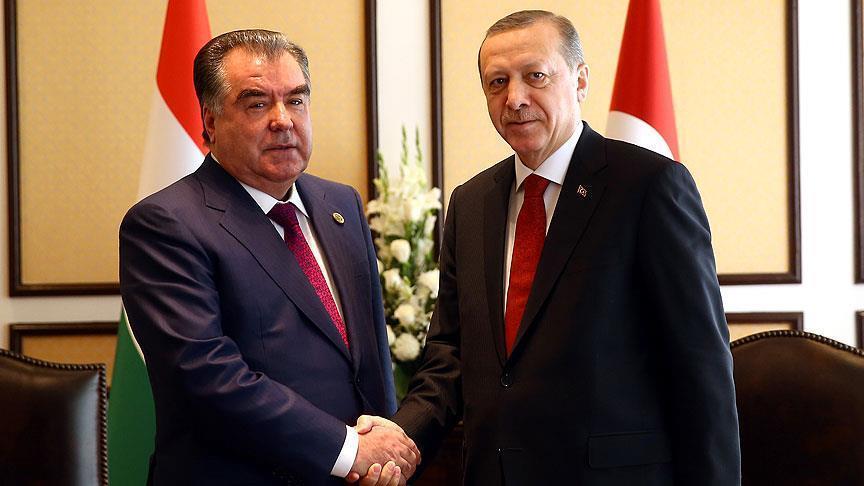
Tajik President Emomali Rahmon yesterday had a telephone conversation with his Turkish counterpart Recep Tayyip Erdoğan.
According to the Tajik president’s official website, the conversation was initiated by the Turkish side.
In the course of the conversation that took place in an atmosphere of friendship and mutual understanding, Rahmon and Erdoğan discussed issues related to state and prospects of further expansion of bilateral cooperation between their countries. They also touched upon a number of regional and international issues being of mutual interest.
Tajik leader, in particular, noted that constant dialogue at the highest level is an important factor for a progressive expansion and strengthening of cooperation between Tajikistan and Turkey both in a bilateral format and within regional and international organizations.
The sides reportedly reached an agreement on specification of dates of Turkish president’s official visit to Tajikistan.
While discussing international problems, Rahmon and Erdoğan expressed serious concern over the situation of Muslim community in Myanmar. They decisively condemned the growth of Islamophobia in that country.
In this regard, the heads of state of both countries declared for a fair solution of all ethnic and religious conflicts only on the basis of peaceful dialogue and called on international community to take effective measures to root out such dangerous occurrences.
Recall, recent violence in Rohingya state has claimed at least 400 lives. The United Nations secretary-general, António Guterres, has appealed to Myanmar to end the violence that has led more than 120,000 Rohingya people to flee in late August, which he warned was “creating a situation that can destabilize the region”.
The unrest has raised fears of a humanitarian crisis in overstretched border camps, with another 400,000 of the Muslim ethnic minority estimated to be trapped in conflict zones in western Myanmar since more “clearance operations” by security forces in Rakhine state began last month.
The Rohingya Muslims are amongst the most persecuted minority group in the world. According to Amnesty International, the Rohingya Muslim people have continued to suffer from human rights violations under the Burmese junta since 1978, and many have fled to neighboring Bangladesh as a result. However, the reality is that the Rohingya people have been oppressed for many years prior to 1978, though arguably not as significant. They have lived in Myanmar for centuries but tensions with Myanmar's Buddhist majority have caused discrimination and harassment. Cases of rape, torture, arbitrary detention, and violence against Rohingya are commonplace, with many incidents going unreported as enforcement officers turn a blind eye.