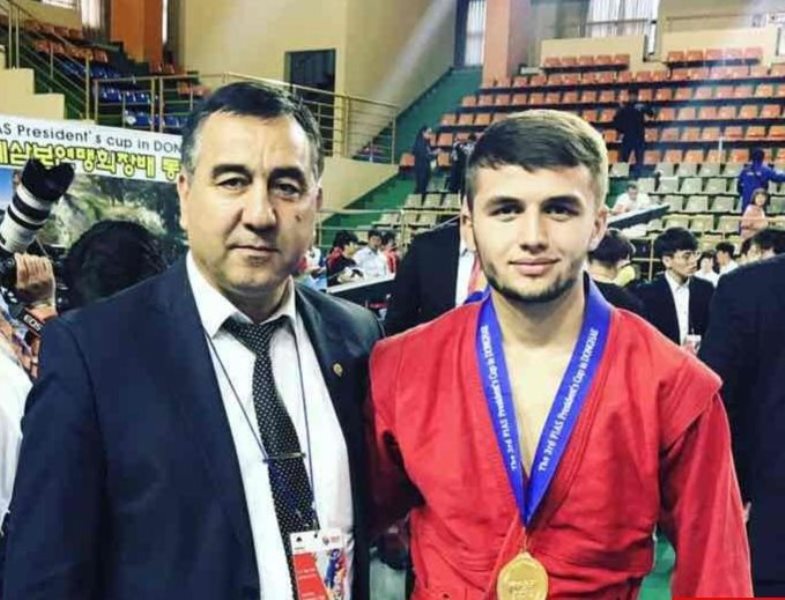
Tajik athlete wins silver medal at Asian Sambo Championships in Mongolia

Tajik athlete Razavi Navabahorov has won silver medal at the 25the Asian Sambo Championships in Mongolia, finishing second in the 70-kg category.   Mongolia hosted the Asian Sambo Championships for the third time and athletes from 14 countries including Iran, Japan, India, Kazakhstan, Tajikistan, China, North Korea, Afghanistan and Uzbekistan were competing in the tournament. According […]

Asia-Plus

Tajik athlete Razavi Navabahorov has won silver medal at the 25the Asian Sambo Championships in Mongolia, finishing second in the 70-kg category.  

Mongolia hosted the Asian Sambo Championships for the third time and athletes from 14 countries including Iran, Japan, India, Kazakhstan, Tajikistan, China, North Korea, Afghanistan and Uzbekistan were competing in the tournament.

According to MONTSAME news agency (Mongolia), more than 400 athletes participated in the 25th Sambo Asian Championships in juniors, youth and adults age categories.

The 25th Asian Sambo Championships were held at the Buyant Ukhaa Sports Complex in Ulaanbaatar between May 10 and 14

Sambo is a Soviet martial art and combat sport (the word "SAMBO" is an acronym for SAMozashchita Bez Oruzhiya, which literally translates as “self-defense without weapons”).  Sambo is relatively modern since its development began in the early 1920s by the Soviet Red Army to improve their hand-to-hand combat abilities.  It was intended to be a merger of the most effective techniques of other martial arts.

The pioneers of sambo were Viktor Spiridonov and Vasili Oshchepkov. Oshchepkov died in prison as a result of the Great Purge after being accused of being a Japanese spy.  Oshchepkov spent several years living in Japan and training in judo under its founder Jigoro Kano.

Spiridonov and Oshchepkov independently developed two different styles, which eventually cross-pollinated and became what is known as sambo.  Compared to Oshchepkov's system, called "Free wrestling" in Russia (known in the West as Catch as Catch Can wrestling or simply Catch wrestling), Spiridonov's style was softer and less brutal.  It was also less strength-dependent, which in large part was due to injuries Spiridonov sustained during World War I.

Anatoly Kharlampiyev, a student of Vasili Oshchepkov, is also considered a founder of sambo.  In 1938, it was recognized as an official sport by the USSR All-Union Sports Committee.

The World Championships in sports and combat SAMBO have been staged since 1973.  The Championship in different years was hosted by Greece, Belarus, the Czech Republic, Bulgaria, Lithuania, Russia and Morocco.     
Join us on social media!

Article translations:

Related Article

Оби зулол
Оби зулол

Most Read

Recent Articles

The only GPW veteran in Dushanbe allocated more than 80,000 somoni

The mayor's office of Dushanbe allocated him 25,000 somoni.

GITEX AI Kazakhstan 2026: how Almaty became the main AI hub of Central Asia

More than 300 companies and startups, over 200 speakers and 100 investors from 50 countries — the region is entering the global stage.

A trade and economic park to be built at the border junction of Tajikistan, Kyrgyzstan, and Uzbekistan

President of the Kyrgyz Republic Sadyr Japarov familiarized himself with the project.

A project to protect soil from degradation to be developed in Central Asia

The initiative is of great significance for the mountainous countries of the region, including Tajikistan.

Mudslide, death, and destroyed homes: hundreds of families in Tajikistan left homeless

A correspondent from "Asia-Plus" visited Kulob and spoke with the families of those who died and were affected by the disaster.

Spring 2026 bright event: new issue of VIPzone now on sale

This issue is about people and ideas that change everything: from business and investments to fashion, food, and urban environment.

Godfrey Sullivan: “Tajikistan is a promising market for Visa to develop digital payments”

The Vice President of Visa explained why Tajikistan is becoming a promising market for digital payments and how artificial intelligence is influencing the future of finance.

Seven students in Dushanbe were threatened with expulsion for arriving at universities in personal cars

The materials for each case have been sent to the Ministry of Education and Science for appropriate actions.

India’s blockchain push and lessons for the global south

The Indian Government has started pushing aggressively its agenda...

India’s blockchain push and lessons for the global south

The Indian Government has started pushing aggressively its agenda...