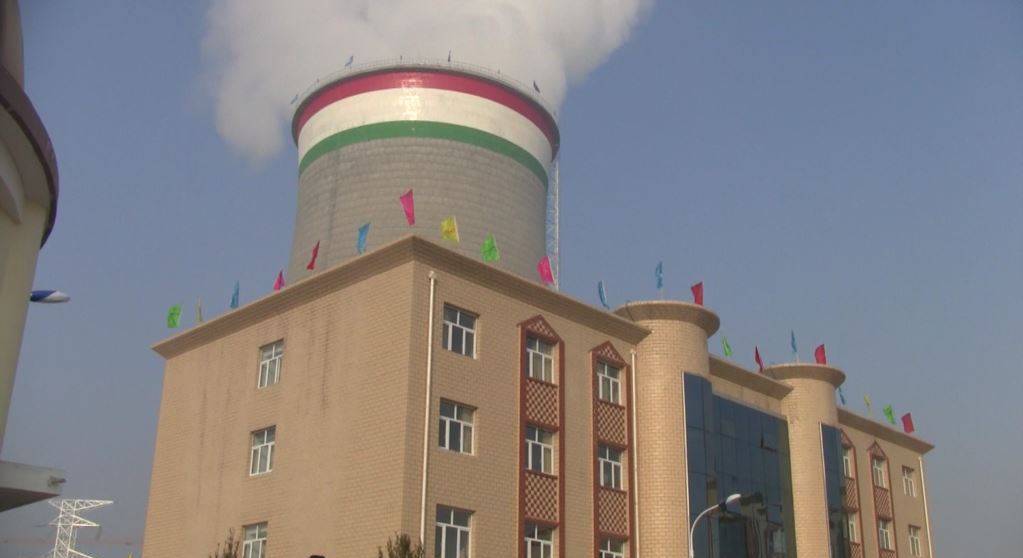
The company currently produces daily up to 4.2 million kilowatt-hours of electricity.
«At the moment, only two units of the Dushanbe-2 heat and power plant are operating, which produce up to 4.2 million kWh of electricity, “Barki Tojik” Company reports». – The launch of two more units of this enterprise will take place later. ».
At the energy holding noted that the company now produces only electricity, as there is no need to produce thermal energy.
The heating season in Dushanbe usually begins in mid-November and lasts until mid-March.
TPP Dushanbe-2 was built by Chinese company TBEA at its own expense in the amount of about $ 350 million. In exchange, the Chinese company gained access to two gold-bearing deposits in the Sughd region – “Duoba” and “Verkhny Kumarg”. The company has the right to use these mines until it returns the money spent on the construction of the Thermal Power Plant.
The first two units of the Dushanbe-2 Thermal Power Plant were commissioned in 2016, and two more units in the autumn of last year. After the company was fully commissioned, for the first time since its independence, Tajikistan fully provided itself with electricity in the autumn-winter period.
The total capacity of Dushanbe-2 TPP is 400 MW of electricity and 360 Gcal of heat. The company is able to generate daily up to 9 million kW/h of electricity, which provides more than 60% of the capital's needs.
Power outages end the other day
Meanwhile, since the beginning of September this year, the population of rural areas complain that they receive electricity only 8-10 hours a day.
These outages at Barki Tojik are associated with maintenance and repair work on lines, substations, and repair of hydroelectric equipment.
«All this is done to ensure that during the cold period of the year to provide the population with electricity without interruption.», – said in the energy holding.
The source noted that maintenance work in some areas has already been completed, and in others will be completed in the coming days.
«We have sufficient resources to fully provide the republic with electricity. However, for this it is necessary to carry out repair work, so that the infrastructure in winter worked properly», – concluded in "Barki Tojik".
Some energy companies connect the shutdowns of the “light” with the filling of the reservoir of the Rogun hydropower plant, the first unit of which is scheduled to be commissioned on November 16.
«Since part of the Vakhsh tributary is retained to fill the Rogun reservoir, the downstream Nurek HPP began to receive less water than usual.», – explained energy scientist on condition of anonymity.
According to the portal Barknest.tj, which carries out daily monitoring of the situation with energy supply, as of October 2 of this year, some areas (Gissar, Rasht, Rudaki, Nurabad, Tavildara, Shahrinav, Asht, J. Rasulov, Devashtich, Shahriston, Muminabad, Nosiri Khusrav, Shakhritus) received electricity only for 7-8 hours a day.
However, today, on October 4, residents of a number of areas close to the capital reported that they began to receive electricity around the clock.
Light and heat rise in price
Meanwhile, from November 1 of this year, the cost of electricity and heat rises by 15%. The corresponding decree was signed by the government of the country on September 25 of this year.
The document decides to approve electricity tariffs for all categories of consumers, except for the SUE "Tajik Aluminum Company".
In particular, for the population it is proposed to increase the tariff for consumed electricity by 15%: from the current 16.85 diram to 19.37 diram for one kilowatt / hour, including VAT.
Each gigacalorie (Gcal) of heat for wholesale customers supplying it to the population rises from the current 7.63 diram to 8.77 diram (by 14.9%).
Heat is provided to the population of the capital by the Dushanbe Heating Networks Enterprise (DHNE), which, in turn, acquires it from the heat and power plants (under the jurisdiction of Barki Tojik).
Acquiring heat energy at the above tariff, DHNE, in accordance with the Antimonopoly Service, establishes its cost for the population. Last year's heating season, the population paid 1.03 somoni for each square meter of usable living space. For the current season, the cost for the population has not yet been established.