

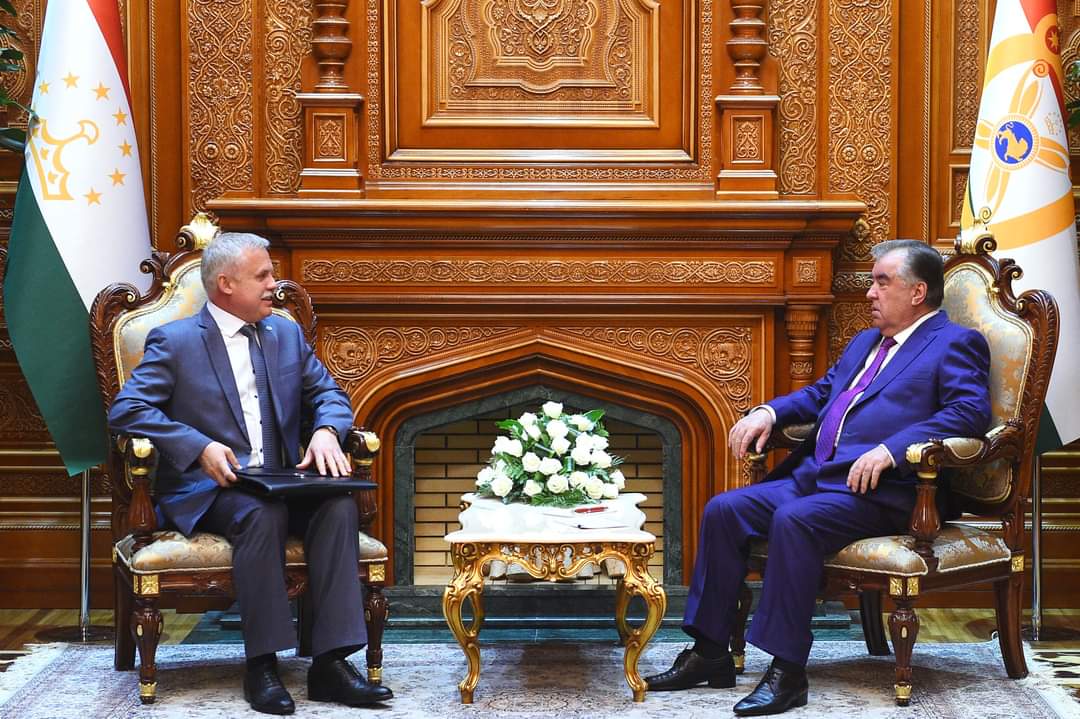
Tajik President Emomali Rahmon yesterday met here with the Collective Security Treaty Organization (CSTO) Secretary-General Stanislav Zas, according to the Tajik president’s official website.
They reportedly discussed priorities of Tajikistan’s rotating chairmanship in the Organization, CSTO current tasks and some urgent matters on the regional and international agenda.
The parties exchanged views on the current political and military situation in the region and considered it necessary to strengthen the capacity to protect Tajikistan’s common border with Afghanistan.
Rahmon and Zas also discussed preparations for the next meeting of the CSTO heads of state that will take place in Dushanbe this year.
Major-General Stanislav Zas is a Ukrainian-born Belarusian general and politician who was formerly the State Secretary of the Security Council of Belarus. Prior to this appointment, Zas had long served as Deputy State Secretary since August 2008. In December 2018, he was made a candidate for the post of Secretary General of the Collective Security Treaty Organization, succeeding Colonel-General Yuri Khachaturov from Armenia. In May 2019, the CSTO's Foreign Ministers nominated Zas to become Secretary General, with his official appointment being on January 1, 2020.
The regional security organization was initially formed in 1992 for a five-year period by the members of the CIS Collective Security Treaty (CST) — Armenia, Kazakhstan, Kyrgyzstan, Russia, Tajikistan, and Uzbekistan, which were joined by Azerbaijan, Georgia, and Belarus the following year. A 1994 treaty reaffirmed the desire of all participating states to abstain from the use or threat of force, and prevented signatories from joining any “other military alliances or other groups of states” directed against members states. The CST was then extended for another five-year term in April 1999, and was signed by the presidents of Armenia, Belarus, Kazakhstan, Kyrgyzstan, Russia, and Tajikistan. In October 2002, the group was renamed as the CSTO. Uzbekistan that suspended its membership in 1999 returned to the CSTO again in 2006 after it came under international criticism for its brutal crackdown of antigovernment demonstrations in the eastern city of Andijon in May 2005. On June 28, 2012, Uzbekistan announced that it has suspended its membership of the CSTO, saying the organization ignores Uzbekistan and does not consider its views. The CSTO is currently an observer organization at the United Nations General Assembly.
