Hisor will host festive buzkashi match tomorrow

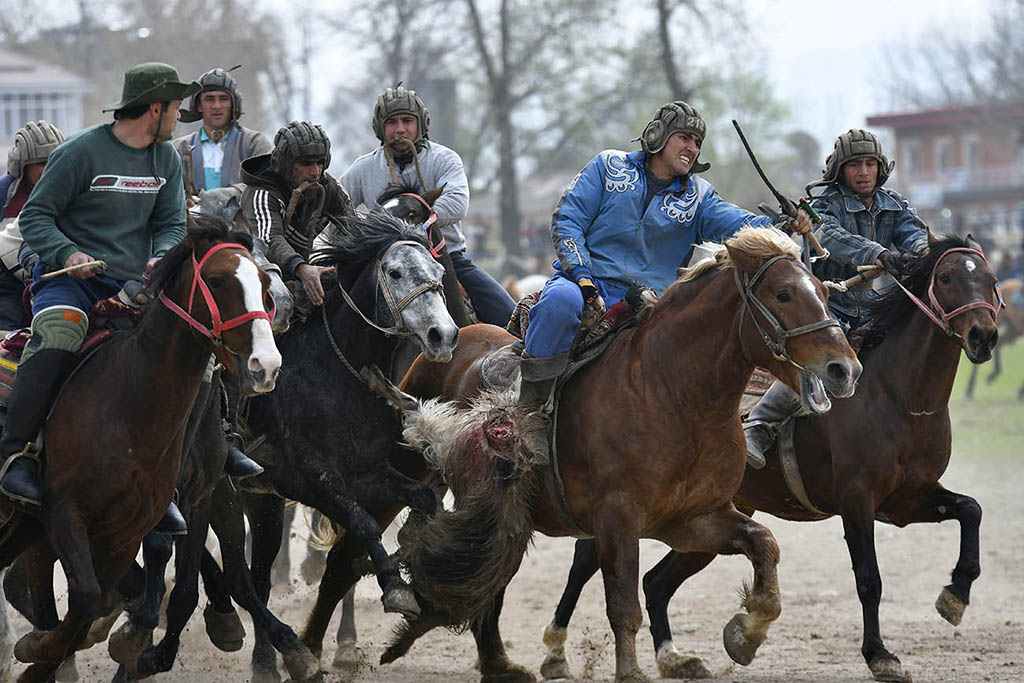
On the occasion of Navrouz festival, a buzkashi match will take place in Hisor district tomorrow, March 20.  According to Hisor administration, the match will be held in Loyob village, Somon jamoat; the starting time: 9:00 am.  “Chovandoz (buzkashi players) from all cities and districts of the country will participate in the match,” the source […]

Asia-Plus

On the occasion of Navrouz festival, a buzkashi match will take place in Hisor district tomorrow, March 20. 

According to Hisor administration, the match will be held in Loyob village, Somon jamoat; the starting time: 9:00 am. 

“Chovandoz (buzkashi players) from all cities and districts of the country will participate in the match,” the source said. 

Buzkashi (goat grabbing) is a traditional Central Asian team sport played on horseback. The steppes' people were skilled riders who could grab a goat or calf from the ground while riding a horse at full gallop. The goal of a player is to grab the carcass of a headless goat or calf and then get it clear of the other players and pitch it across a goal line or into a target circle or vat.  It is very dangerous.

The game is known as Buzkashi in Afghanistan and Tajikistan and among Persian-speaking populations of Central Asia, while in Kyrgyzstan, Kazakhstan, and Uzbekistan, the game is referred to as Kok-boru or Ulak Tartysh

Buzkashi began as a sport of the steppes. It is a popular game among the south Central Asians such as the Tajiks, Uzbeks, Hazars, Kyrgyz, Kazakhs, Turkmens and Pashtuns. 

Competition is typically fierce, as other players may use any force short of tripping the horse in order to thwart scoring attempts.  Riders usually wear heavy clothing and head protection to protect themselves against other players' whips and boots. Games can last for several days, and the winning team receives a prize, not necessarily money, as a reward for their win.

The game consists of two main forms: Tudabarai and Qarajai. Tudabarai is considered to be the simpler form of the game.  In this version, the goal is simply to grab the calf and move in any direction until clear of the other players.  In Qarajai, players must carry the carcass around a flag or marker at one end of the field, then throw it into a scoring circle (the "Circle of Justice") at the other end.  The riders will carry a whip, often in their teeth, to fend off opposing horses and riders.

Serious Buzkashi players train intensively for years, and many of the masters (called chapandaz) are over forty years old.  Playing well also requires specially trained horses that know to stop still when a rider is thrown and to gallop forcefully when their rider gets hold of the calf.  These horses can sell today for as much as US$10,000 to US$15,000.
Join us on social media!

Article translations:

Related Article

Оби зулол
Оби зулол

Most Read

Recent Articles

The only GPW veteran in Dushanbe allocated more than 80,000 somoni

The mayor's office of Dushanbe allocated him 25,000 somoni.

GITEX AI Kazakhstan 2026: how Almaty became the main AI hub of Central Asia

More than 300 companies and startups, over 200 speakers and 100 investors from 50 countries — the region is entering the global stage.

A trade and economic park to be built at the border junction of Tajikistan, Kyrgyzstan, and Uzbekistan

President of the Kyrgyz Republic Sadyr Japarov familiarized himself with the project.

A project to protect soil from degradation to be developed in Central Asia

The initiative is of great significance for the mountainous countries of the region, including Tajikistan.

Mudslide, death, and destroyed homes: hundreds of families in Tajikistan left homeless

A correspondent from "Asia-Plus" visited Kulob and spoke with the families of those who died and were affected by the disaster.

Spring 2026 bright event: new issue of VIPzone now on sale

This issue is about people and ideas that change everything: from business and investments to fashion, food, and urban environment.

Godfrey Sullivan: “Tajikistan is a promising market for Visa to develop digital payments”

The Vice President of Visa explained why Tajikistan is becoming a promising market for digital payments and how artificial intelligence is influencing the future of finance.

Seven students in Dushanbe were threatened with expulsion for arriving at universities in personal cars

The materials for each case have been sent to the Ministry of Education and Science for appropriate actions.

India’s blockchain push and lessons for the global south

The Indian Government has started pushing aggressively its agenda...

India’s blockchain push and lessons for the global south

The Indian Government has started pushing aggressively its agenda...