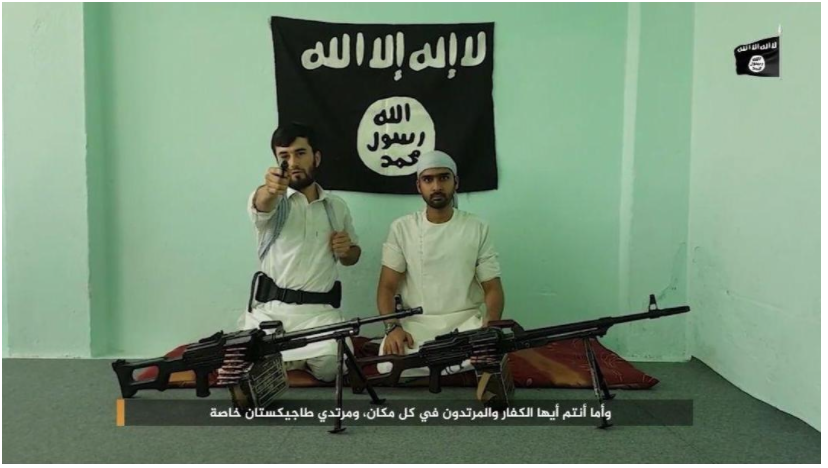
An article posted on the Eurasianet’s website says the ISIS affiliate, known as the Islamic State Khorasan Province or ISIS-K, is reaching out to minorities in Afghanistan and their ethnic cousins in post-Soviet Central Asia.
ISIS-K has recently ramped up the production, translation, and dissemination of propaganda directed at Uzbek, Tajik, and Kyrgyz speakers in the region.
Perspectives | Islamic State in Afghanistan Seeks to Recruit Uzbeks, Tajiks, Kyrgyz notes that this push comes as part of an information campaign to delegitimize Kabul’s new Taliban government as a Pashtun ethno-nationalist organization rather than a bona fide Islamic movement. Accordingly, ISIS-K reportedly sees an opportunity to exploit areas of tension between the Taliban and different ethnic groups that may feel marginalized, while seeking to inspire attacks further afield in Uzbekistan, Tajikistan, and Kyrgyzstan.
“Al-Azaim, ISIS-K’s dominant media organ, has begun publishing in Central Asian languages,” says the article. “For example, since February 1, Al-Azaim has published two books in Uzbek including a long text slandering the Taliban as slaves of China, Russia, the U.S., Pakistan and Turkey; both appear in the Latin alphabet used in Uzbekistan. It has released at least 15 audio recordings in Uzbek.”
In the Tajik Cyrillic used in Tajikistan, Al-Azaim earlier this month reportedly released a book, “Why Jihad is Obligatory.” The religious text criticizes movements that claim to fight for jihad but, according to the author, are instead “apostates,” pointing to the Free Syrian Army, the al-Hashd al-Shabi in Iraq, and the Taliban in Afghanistan.
By addressing ethnic groups in formerly Soviet Central Asia, Islamic State militants know they are sowing potentially fertile ground, according to the article.
Without a doubt, the spread of ISKP propaganda should worry Central Asian governments, who have never been targeted by the Taliban.
According to some sources, ISIS-K nearly doubled in size to more than 4,000 fighters during the Taliban takeover of Afghanistan last year.
The commander of U.S. forces in the Middle East and South Asia said on March 15 that without sustained pressure from the U.S. and U.S.-backed Afghan forces, is solidifying its foothold.
McKenzie said that ISIS-K will be able to conduct attacks out of Afghanistan in 12 to 18 months.
The US CENTCOM commander added, though the Taliban have been suppressing the terror groups across Afghanistan but warned that ISIS-K will ramp up its attacks in the summer even in Kabul.
McKenzie in his final appearance before Senate Panel said the Taliban did not help themselves by releasing one thousand ISIS-K affiliates from Afghanistan’s jail following their takeover in August last year.
ISIS-K is active in South Asia and Central Asia. ISIS-K has been active in Afghanistan and its area of operations includes Pakistan, Tajikistan and India where they claimed attacks, as well as Sri Lanka, the Maldives, Bangladesh and China where individuals have pledged allegiance to it. The ISIS-K and Taliban consider each other enemies.
The group was created in January 2015 by disaffected Taliban in eastern Afghanistan, although its membership includes individuals from various countries notably Pakistan, Bangladesh, India and Myanmar. Its initial leaders, Hafiz Saeed Khan and Abdul Rauf Aliza, were killed by US forces in July 2016 and February 2015, respectively. Subsequent leaders have also been killed; its leader Abdullah Orokzai was captured in April 2020 by Afghanistan's intelligence service.