5.2 billion somonis spent last year on construction of the Roghun hydropower plant

In a report released at a news conference in Dushanbe, Finance Minister Faiziddin Qahhorzoda revealed on February 16 that the government last year spent 5.2 billion somonis (US$475 million) on construction work at the site for construction of the Roghun hydropower plant, which is 2.7 billion somonis more than had been planned. The projected government […]

Asia-Plus

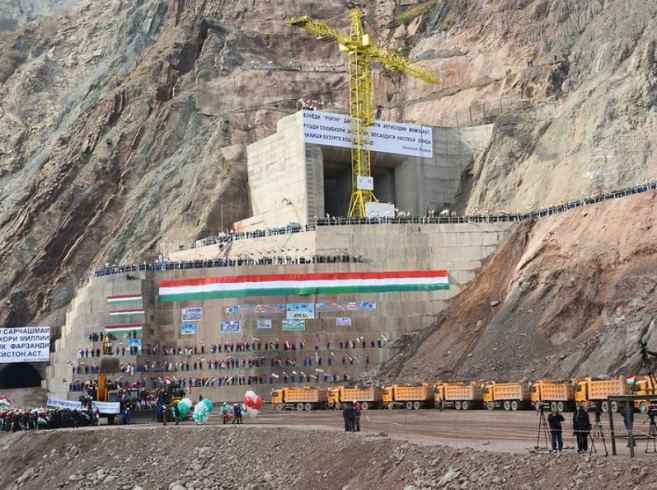
In a report released at a news conference in Dushanbe, Finance Minister Faiziddin Qahhorzoda revealed on February 16 that the government last year spent 5.2 billion somonis (US$475 million) on construction work at the site for construction of the Roghun hydropower plant, which is 2.7 billion somonis more than had been planned.

The projected government spend for this year, meanwhile, is 5 billion somonis.  It is projected that 2.2 billion somonis can be solicited from foreign-based parties, the minister noted. 

When work on Roghun, a project that was in its origins the brainchild of Soviet engineers, resumed in earnest in 2008, the estimate for the overall cost stood at US$3 billion.

This climbed upward through the years.

In 2016, officials threw around the figure of US$3.9 billion.  In mid-2022, the Energy Ministry announced US$5 billion would be needed for full project implementation.

On February 1, Energy Minister Daler Juma offered a new forecast: US$6.2 billion.  That is high, although admittedly quite a bit short of the US$8 billion prognostication he volunteered in an interview to Reuters news agency in June 2022.

The first generating units of the Roghun hydropower plant were introduced into operation in November 2018 and September 2019 to much clamor, but there has been limited progress since then.  The third unit is expected to be introduced into operation in 2025.   

Once completed, Roghun will be fitted with six 600 megawatt turbines, amounting to a total installed capacity of 3,600 megawatts.  Eurasianet notes that as Milan-based WeBuild (formerly Salini Impregilo), which has been contracted to implement the project, has claimed on its website, that is “the equivalent of three nuclear power plants.”

Current annual electricity production in Tajikistan, much of which is accounted for by the Soviet-vintage Nurek hydropower plant, is around 17 billion kilowatt-hours.

Putting this together, it implies that Roghun has, since the first generating unit began working, likely contributed to well under one-tenth of Tajikistan’s electricity output, according to Eurasianet

Join us on social media!

Article translations:

Related Article

Оби зулол
Оби зулол

Most Read

Recent Articles

The only GPW veteran in Dushanbe allocated more than 80,000 somoni

The mayor's office of Dushanbe allocated him 25,000 somoni.

GITEX AI Kazakhstan 2026: how Almaty became the main AI hub of Central Asia

More than 300 companies and startups, over 200 speakers and 100 investors from 50 countries — the region is entering the global stage.

A trade and economic park to be built at the border junction of Tajikistan, Kyrgyzstan, and Uzbekistan

President of the Kyrgyz Republic Sadyr Japarov familiarized himself with the project.

A project to protect soil from degradation to be developed in Central Asia

The initiative is of great significance for the mountainous countries of the region, including Tajikistan.

Mudslide, death, and destroyed homes: hundreds of families in Tajikistan left homeless

A correspondent from "Asia-Plus" visited Kulob and spoke with the families of those who died and were affected by the disaster.

Spring 2026 bright event: new issue of VIPzone now on sale

This issue is about people and ideas that change everything: from business and investments to fashion, food, and urban environment.

Godfrey Sullivan: “Tajikistan is a promising market for Visa to develop digital payments”

The Vice President of Visa explained why Tajikistan is becoming a promising market for digital payments and how artificial intelligence is influencing the future of finance.

Seven students in Dushanbe were threatened with expulsion for arriving at universities in personal cars

The materials for each case have been sent to the Ministry of Education and Science for appropriate actions.

India’s blockchain push and lessons for the global south

The Indian Government has started pushing aggressively its agenda...

India’s blockchain push and lessons for the global south

The Indian Government has started pushing aggressively its agenda...