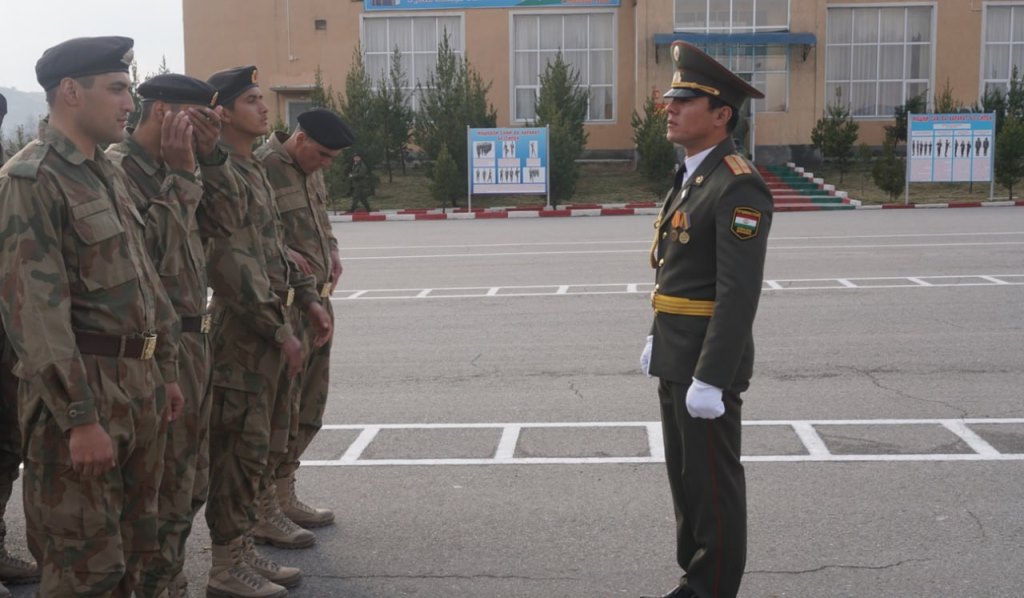
The NGO Office of Civil Liberties published a report on human rights monitoring in military units of Tajikistan's Ministry of Defense. The focus was on remote, mountainous regions. Soldiers were questioned about extortion, food quality, and awareness of their rights.
This annual monitoring, conducted since 2014, this year, reportedly covered 41 units, including Ishkashim district and the city of Khorog in the Gorno-Badakhshan Autonomous Region (GBAO), Mastchoh district in Sughd province, and Kushoniyon district in Khatlon province.
Surveys included 40 soldiers and officers, with representatives from both the NGO and the Human Rights Ombudsman’s office.
Key findings:
- No extortion or desertion: soldiers reported no cases of extortion or desertion. Salaries are reportedly used for personal needs and hygiene products.
- Complaint mechanisms: awareness of how to file complaints is limited. Only five soldiers mentioned the existence of complaint boxes. In some units, boxes were either absent or locked, with unclear key holders.
- Awareness of rights: of 40 soldiers, 38 claimed to know their rights but could name only 1–2, primarily related to leave and rest. None mentioned rights to information or filing complaints. Awareness is improving compared to past years, with soldiers now recognizing basic entitlements like food, rest, and medical care.
At the same time, no soldier mentioned rights to access information or file complaints.
However, human rights activist, Ms. Dilrabo Samadova, says progress is evident.
"In the past, when we asked soldiers about their rights, they mostly listed duties: knowing regulations, obeying commanders, and maintaining a neat appearance. Now they talk about rights to food, rest, family communication, phone calls, medical care, and overall decent living standards. This is very encouraging," she stated.
Additionally, the number of soldiers with higher education has increased this year, contributing to a reduction in non-statutory relations, improving the quality of military service, and raising the qualifications of servicemen, among other benefits.
For comparison, in 2021, only 6 out of 58 soldiers had higher education, while in 2024, 17 out of 40 soldiers held higher degrees, according to the monitoring report.
Living conditions:
- Medical care — soldiers acknowledged the availability of medical facilities and expressed satisfaction with services.
- Food quality — meals were rated well, including vegetables, meat, dairy, and occasional fruit and fish.
- Uniforms and sports — soldiers are adequately equipped, but some units lack facilities for indoor sports during bad weather.