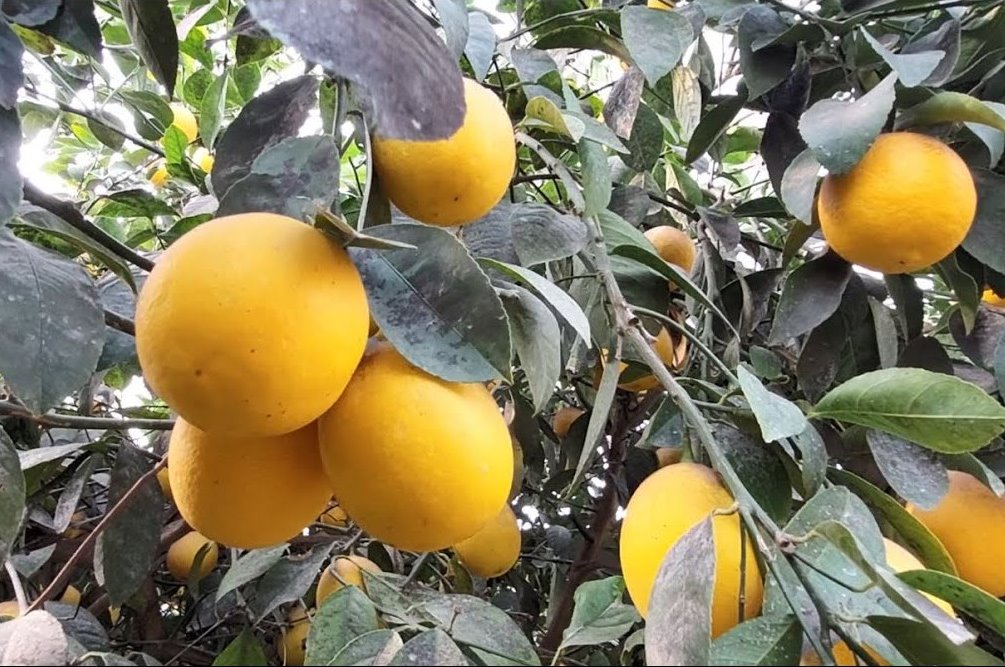
Tajik lemons are steadily securing a position in international markets. Despite a slight decline in export volumes, lemons from Tajikistan remain in demand in Kazakhstan, Russia, and Belarus.
The development of greenhouse technologies, the introduction of new varieties, and government support open up significant opportunities for the industry, making citrus cultivation a key element of the national economy.
From greenhouses to the global market
According to the Customs Service, Tajikistan exported over 2,000 tons of lemons worth approximately US$672,000 over the first 11 months of 2024.
Although this marks a reduction compared to 2023, when 2,400 tons were exported, generating about US$805,000 in revenue, Tajik lemons continue to be sought after in international markets. The primary importers of the product are Kazakhstan, Russia, and Belarus.
According to Saidali Gulov, a professor at the Tajik Agrarian University, citrus farming, especially lemon cultivation, is a highly profitable sector that can significantly strengthen the country’s economy. However, the share of citrus fruits in the total agricultural output remains at 5–6%.
New technologies in lemon orchards: from 150 to 500 quintals per hectare
Tajikistan has more than 5,300 hectares of citrus orchards, with lemons comprising the majority. Lemon yields average 150 quintals per hectare, but in some farms, they reach a record 500 quintals thanks to new varieties developed by Tajik breeders.
The Meyer lemon remains the most popular variety, grown on plantations covering more than 500 hectares.
In Khatlon Province, particularly in the Qumsangir district, lemon orchards play a significant role in the local economy. Here, 90% of the population is engaged in citrus cultivation, with over 100 hectares of greenhouses devoted to lemons.
Trench and surface methods are used to optimize land utilization, effectively adapting the technology to the region’s climate. These methods require minimal land—just 0.013 to 0.02 hectares.
Under the Horticulture, Viticulture, and Citrus Development Program for 2025–2029, significant advancements in citrus farming are planned. New types of greenhouses and technologies will be introduced to boost productivity and export potential.
The program’s funding is estimated at 691 million somonis, with 375 million allocated for the first phase (2025–2027).
The program aims to establish over 113 hectares of new citrus orchards across Sughd, Khatlon, Gorno-Badakhshan Autonomous Region (GBAO), and districts under republican jurisdiction.
Experts emphasize that the trench citrus cultivation methods were first developed by Tajik scientists in the 1930s.
Special attention is being paid to adapting lemon varieties to specific regions. For instance, the “Vakhsh” and “Dusti” varieties are recommended for GBAO, “Vakhsh” and “Khatlon” for Khatlon, and “Vakhsh,” “Dusti,” and “Tajikistan” for Sughd.
Economic and export potential
In the coming years, Tajikistan plans to increase lemon exports to 7,000 tons. The lemon business is highly profitable, with one hectare yielding 8–10 times more revenue than other fruit crops. For beginner farmers, starting with a 10-sotka (0.1 hectare) plot is recommended, which can accommodate up to 200 seedlings. Each tree can produce 30 to 100 kg of fruit.
With government support, the adoption of modern technologies, and a focus on exports, citrus farming has the potential to become a key sector of the economy, providing stable income for farmers and the nation as a whole.