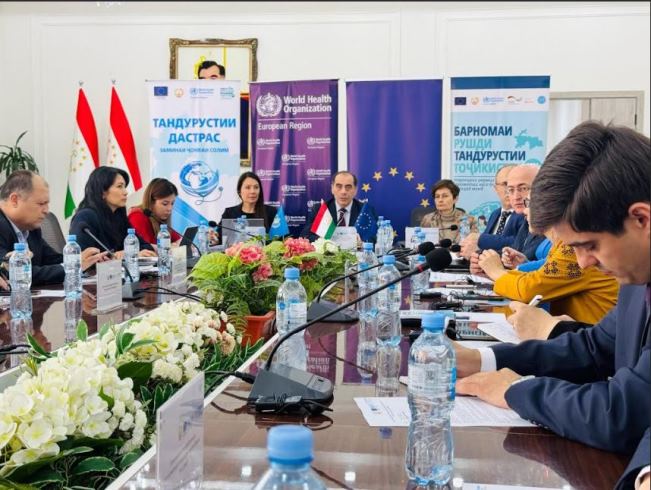
The World Health Organization (WHO), in partnership with the Ministry of Health and Social Protection of the Population of Tajikistan (MoHSPP), successfully hosted a participatory workshop on evidence-informed decision-making on April 10th, followed by a high-level roundtable discussion on April 11. These events, supported by the European Union (EU) under the Health Development Program (2021-2025), mark a significant step in integrating research-based evidence into Tajikistan’s health policymaking processes.
Evidence-informed decision-making (EIDM) involves using the best available data and research to shape policy, ensuring that decisions are based on evidence. This is crucial for improving transparency and efficiency in public health governance. By relying on rigorous data analysis, the quality, relevance, and effectiveness of healthcare services is improved. Despite the benefits of this approach, embedding EIDM into policymaking remains a challenge, requiring strategic interventions across institutions and levels of government.
“These events not only built capacity among Tajikistan’s policymakers but also laid a strong foundation for integrating evidence into policymaking. This will result in health policies that more effectively improve the health and well-being of Tajikistan’s population,” said Dr. Tanja Kuchenmüller, EIDM expert from WHO Headquarters.
The workshop and roundtable reportedly brought together key stakeholders, including policymakers, researchers, and international experts, to assess the status of EIDM in Tajikistan and to develop priority actions to further institutionalize evidence-informed decision-making in health governance.
Key outcomes:
- Presentation of EIDM Situation Analysis – Findings from a national assessment on the current use of evidence in health policy formulation were shared and discussed.
- Strategic Dialogue on Institutionalization – Participants engaged in discussions on the benefits, challenges, and pathways for embedding EIDM into Tajikistan’s health sector governance.
- Development of Priority Actions – Priority actions for short-, medium-, and long-term planning were outlined to define the next steps for strengthening institutional capacity, stakeholder engagement, and governance structures for EIDM implementation. These actions were validated by the MoHSPP Health Analysis Unit and experts from WHO.
This initiative aligns with WHO’s global efforts to strengthen evidence-to-policy translation and reflects Tajikistan’s commitment to enhancing health sector governance, financing mechanisms, and policymaking capacity.
WHO acknowledges the strong partnership with the MoHSPP and the EU in advancing this agenda and looks forward to continued collaboration in implementing evidence-informed health policies that improve health outcomes for all.
With over 60 million euros invested over the past decade, the EU remains committed to achieving Universal Health Coverage in Tajikistan. Now in its final year, the Health Development Program is focused on working with implementing partners to ensure lasting, sustainable improvements to the country’s health system.