A team of international scientists has extracted a rare ice core from the Pamir Mountains in Tajikistan and delivered it to Europe, where it will be preserved for future climate research. The announcement was made during an international conference on climate change and water resources, held in Dushanbe on October 13.
The ice core is now stored at the Ice Memory Foundation, a global initiative dedicated to safeguarding climate data frozen within glaciers, led by Swiss scientist, Professor Thomas Stocker.
Historic extraction on the Pamirs: a first for climate science
This marks the first time a deep ice core has been extracted from the Pamirs. Containing information dating back over a thousand years, the core is expected to offer invaluable insights into the historical climate of Central Asia and the impact of climate change on mountain ecosystems.
“Studying glacier data is critical for understanding global climate shifts,” Stocker said. “We plan to store these samples in specialized labs for detailed analysis.”
How scientists measured the ice
Unlike conventional studies focused on glacier length, the expedition emphasized measuring ice volume — providing a more accurate assessment of the region’s remaining water reserves.
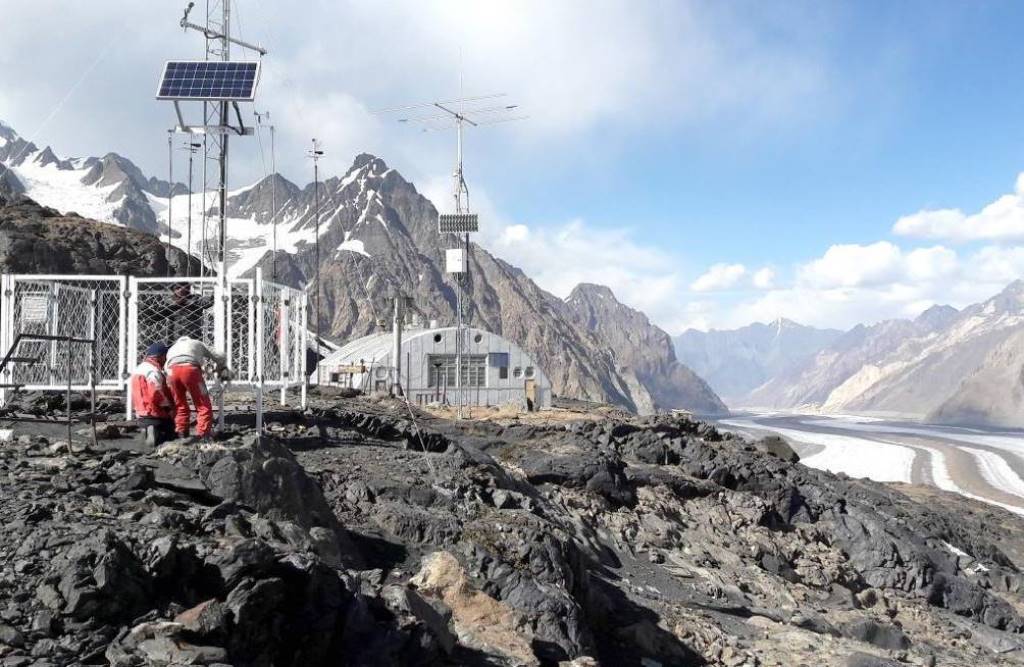
Researchers measured eight glaciers, many located at altitudes over 5,000 meters, requiring helicopter access and specialized equipment.
“Measuring volume, not just length, gives us a clearer picture of how much ice is actually left,” said researcher Evan Miles.
Unlocking the climate of the past — and the future
The expedition drilled to depths of over 100 meters to extract the ice core. Scientists also measured internal glacier temperatures, critical for understanding how warming affects ice structure and behavior.
This data will be used to predict future climate scenarios and guide adaptation strategies in the region.
Extreme conditions and logistical challenges
Working in temperatures as low as -15°C, the international team faced harsh weather, high altitudes, and difficult transport logistics.
“Weather, cold, and logistics were real challenges. But our team’s unity and international cooperation made it possible,” said Thomas Sachs, one of the lead researchers.
The transport of the ice from the high-altitude glaciers to Dushanbe, and later to Europe, was one of the most demanding parts of the mission.
What comes next: a two-year scientific mission
The expedition is set to continue through 2026. Researchers plan additional drilling and data collection to deepen understanding of how climate change is reshaping the glaciers of the Pamirs and Central Asia.
“We’ll be working in the region for two more years. This will help us gather more data on how ecosystems are being affected,” said Sachs.
Why this matters for Central Asia
For Tajikistan and its neighbors, where glaciers provide vital freshwater, this research is critical. The melting of Pamir glaciers threatens to disrupt regional water supplies and increase the risk of natural disasters like floods and glacial lake outbursts.
The findings will support:
· Climate adaptation strategies
· Early-warning systems for disasters
· Water resource planning for the entire region
“The cryosphere is essential to water security in Central Asia,” said Nazriallo Sheralizoda, Director of the Glaciology Center at Tajikistan’s National Academy of Sciences.
“Glaciers aren’t just sources of freshwater — they’re also emerging sources of risk due to climate change.”
A national and international collaboration
The project is organized by the State Glaciology Center under Tajikistan’s National Academy of Sciences, with support from international research institutions.
As climate change accelerates, the glaciers of the Pamirs — once seen as eternal — are becoming a crucial archive of the past and a warning for the future.