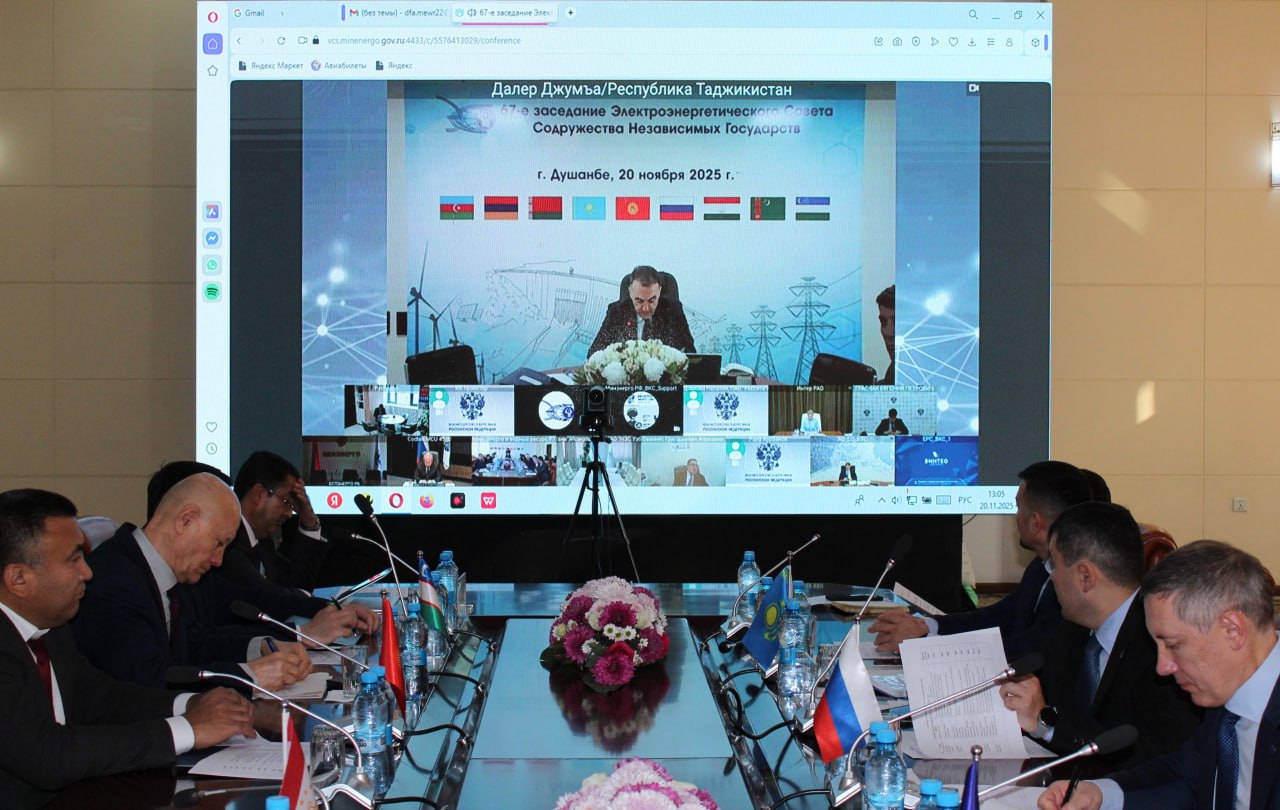
Tajikistan will complete the integration of its northern region into the Central Asian unified power grid in the first half of 2026, Energy and Water Resources Minister Daler Juma announced at the 67th meeting of the CIS Electric Power Council, which was held in Dushanbe on November 20.
He reportedly noted that the southern southwest region of the country was connected to the grid in June 2024.
The high-level gathering included energy ministers and deputy ministers from CIS countries, representatives of the CIS Electric Power Council Executive Committee, the Shanghai Cooperation Organization (SCO), as well as energy sector experts and research institutions.
In his address, Juma highlighted that since 2000, over 20 energy projects worth more than $2.5 billion have been implemented in Tajikistan. These efforts include the construction and modernization of substations and power lines, reconstruction of large infrastructure sites, installation of new metering systems, and upgrading of electrical networks across all voltage levels.
The minister also reported progress on the CASA-1000 project, noting that both the Tajik and Kyrgyz sections of the transmission line are operational, laying the foundation for future electricity exports.
He emphasized the strategic importance of hydropower for Tajikistan. Key projects such as the Roghun Hydropower Plant — with a planned capacity of 3,780 MW — are under construction and are expected to play a central role in the country’s energy balance.
Juma added that by 2030, Tajikistan aims to commission at least 3,000 MW of solar and wind power capacity. These renewable energy sources will help stabilize electricity supply during the winter months, when hydropower generation typically decreases due to reduced water inflow.
He also noted ongoing cooperation with Russia through the Sangtuda-1 HPP and with Uzbekistan on joint hydropower projects in the Zarafshon River basin.
Participants at the meeting reportedly discussed strategies to strengthen energy cooperation among CIS and SCO member states, the progress of the CASA-1000 initiative, the CIS Energy Development Strategy through 2035 (with projections to 2050), and broader issues related to hydropower and renewable energy development.
The next, 68th meeting of the CIS Electric Power Council will be held in 2026 in Kazan, Russia.
The CIS Electric Power Council (EPC CIS) was established on February 14, 1992, through an intergovernmental agreement aimed at coordinating cooperation in the field of electric power among CIS member states. The council includes Azerbaijan, Armenia, Belarus, Kazakhstan, Kyrgyzstan, Moldova, Russia, Tajikistan, Turkmenistan, and Uzbekistan.
It is to be noted that Tajikistan is poised to rejoin the Central Asian Unified Power Grid (CAUPG), more than a decade after its operations were disrupted following regional tensions and disconnection from neighboring countries.
The development marks a significant shift in regional energy cooperation, with Tajikistan now nearing self-sufficiency in electricity production and ready to reintegrate into the regional network.
Back in November 2009, tensions escalated when Kanat Bozumbayev, then top executive at Kazakhstan's national electricity grid operator KEGOC, accused Tajikistan of illegally drawing more power from the grid than allocated. “Tajikistan is siphoning electricity without agreements or payments,” Bozumbayev stated, warning that Kazakhstan would leave the parallel grid regime if the issue persisted.
Tajikistan firmly rejected the accusations, arguing that it lacked the technical capability to extract electricity from the grid without authorization.
The situation intensified in December 2009 when Uzbekistan officially withdrew from the regional power grid that had connected the four Central Asian countries. Tajik and Kyrgyz authorities criticized the move, calling it an attempt to exert political pressure. The withdrawal disrupted power transmission routes, as many areas in Tajikistan and Kyrgyzstan relied on electricity passing through Uzbek territory, leading to severe winter shortages.
However, Tajikistan has since significantly expanded its energy capacity. With new power facilities in operation—including the ongoing development of the Roghun hydroelectric power plant (HPP)—the country now meets nearly all of its domestic electricity needs.
According to Tajikistan's Ministry of Energy and Water Resources (MoEWR), the national power system is now fully prepared for parallel operation within the CAUPG. On December 2, 2021, Tajik Minister of Industry and New Technologies Sherali Kabir announced that Tajikistan would rejoin the regional grid in 2022. He made the remarks in response to a Russian proposal to restore the CAUPG, emphasizing the importance of adapting to global and regional energy market changes.
“With the launch of the Roghun HPP, there will be an opportunity to reshape the regional power market and address electricity shortages in Central Asia,” Kabir stated.
Progress on Tajikistan's reintegration continues. On May 14, 2024, Uzbekistan's Minister of Energy, Jurabek Mirzamahmudov, said at an international energy conference in Tashkent that Tajikistan was expected to reconnect to the CAUPG that month. His remarks were later confirmed by regional media, signaling renewed cooperation across the grid.
In parallel, a trilateral energy cooperation initiative is also taking shape. In May 2024, Azerbaijan, Kazakhstan, and Uzbekistan signed a Memorandum of Understanding (MoU) to unify their power systems. The agreement, signed in Tashkent by the countries’ ministers of economy and energy, aims to enhance cooperation in green energy production and enable electricity exports to Europe via Azerbaijan.