A surge in meat prices across Tajikistan has triggered market inspections and a wave of fines, but experts argue that such enforcement measures fail to address the root causes of rising costs. The main drivers include higher feed prices, fuel costs, transportation expenses, and a drop in livestock numbers, particularly among small private farms.
According to the Interior Ministry’s department in Dushanbe, 120 administrative protocols have been issued on city markets for alleged price gouging and consumer fraud. Violations were filed under Articles 555 and 627 of Tajikistan’s Code of Administrative Offenses. However, a closer look reveals that these penalties are not always legally justified.
When can a seller be fined?
Under the Regulation on the Formation and Application of Free Prices, a seller may be fined if they: set prices unlawfully; deceive consumers; or sharply increase prices without valid justification.
Meat is classified as a socially significant commodity, meaning the state has the authority to limit markups or set maximum retail prices—but only after an official order from the Antimonopoly Service. If no such order exists, pricing remains free-market based, and fining sellers for “high” prices becomes unlawful.
What counts as consumer fraud
Article 627 of the Administrative Code covers cases such as: underweighing; false price labeling; hidden fees; or selling low-quality meat as premium cuts.
These actions are considered misleading and are subject to fines.
How much have meat prices risen
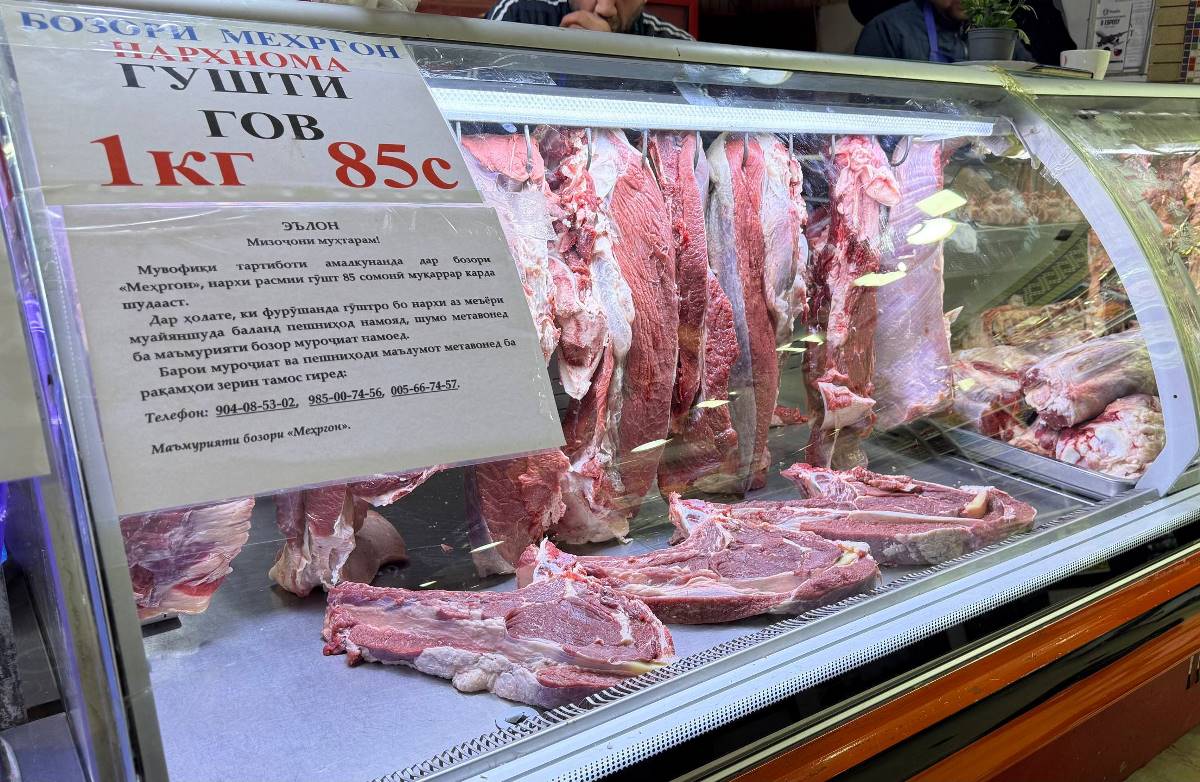
Media reports show that in Dushanbe, beef prices jumped from 85–95 somonis per kilogram to 110–145 somonis within a month—an increase of 30–40%. This far exceeds the 20% threshold set by law, potentially justifying state intervention. Yet, real market dynamics often differ from official statistics, as confirmed by both consumers and vendors.
How meat prices are formed in Tajikistan
Meat prices in Tajikistan consist of several components: production costs, taxes, markup, and vendor profit. Production costs include the purchase of livestock, feeding, transportation, and slaughter.
In Khatlon province, live cattle prices range from 50 to 55 somonis per kilogram, while in Sughd province and the Hisor Valley (western Tajikistan), prices can exceed 60 somonis. Given a slaughter yield of 50–65%, the actual cost of producing one kilogram of meat can reach 85 to 100 somonis.
Feed prices—another key factor—have also surged. Cottonseed meal costs up to 6 somoni per kg, and alfalfa bales sell for as much as 45 somonis. These expenses push meat prices higher before the product even reaches the market.
Why fines don’t work
Economists argue that fines won’t solve the core issue: high production costs. As economist Sobir Qurbonov points out, price regulation is only legal under market monopoly or collusion—otherwise, it violates the principles of a free economy.
“Prices are set by the market, and the government should focus on addressing supply shortages, boosting competition, and reducing production costs—not punishing retailers,” Qurbonov said.
He suggested the following reforms: exempting meat producers from VAT; subsidizing feed; and supporting the development of large-scale feedlot operations.
What can be done to lower meat prices
Experts and producers agree: reducing meat prices is only possible by cutting production costs. Key measures include:
• Developing large-scale feedlot operations, which reduce costs by leveraging economies of scale and can cut production expenses by 10–15%.
• State support for farmers, including subsidies for feed, affordable loans to expand livestock numbers, and modernization of farms.
• Creating “social meat outlets”, where meat is sold at reduced prices—a model already used successfully in Turkey and Kazakhstan.
• Meat imports during seasonal shortages, to help stabilize the market temporarily.
• Reducing the role of intermediaries, ensuring more direct sales from producers to consumers.
Regional experience
Kazakhstan focuses on subsidizing feed, developing large-scale farms, and strict antimonopoly control. Uzbekistan relies on meat imports and limits middlemen to lower final prices. In Russia, large agricultural holdings and subsidized feed help reduce production costs at scale.
Conclusion: economic measures, not fines, are the solution
Fining vendors for “overpriced” meat doesn’t solve the core issue—high production costs. It doesn’t affect the cost of feed, transport, or slaughter. In fact, heavy-handed inspections may backfire, as sellers factor fines and risks into their pricing.
Only economic tools can stabilize prices: farm support, infrastructure development, tax relief, and transparent supply chains.
“Instead of sending police to the markets, the government should be using real economic instruments,” said economist Sobir Qurbanov. He also urged exempting dairy and meat producers from VAT and ensuring access to affordable feed.
Systemic, long-term measures—not enforcement actions—will make meat more affordable for consumers.