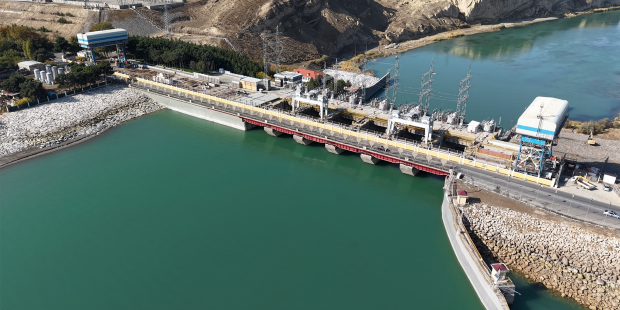
All six generating units of the Qayroqqum hydropower plant (HPP) have been fully modernized and put into operation. Landscaping and site improvement works at the plant are scheduled to be completed by December 2026, the station’s management reported.
The completion of the modernization marks a major milestone in a large-scale project aimed at strengthening the energy resilience of Sughd Province and Tajikistan as a whole, while significantly improving the efficiency of one of the country’s key energy facilities According to the plant’s director, Fayzullo Avezov, told Energetika i Vodnyye Resursy (Energy and Water Resources) magazine in an interview
The modernization, which began in 2019, has substantially enhanced the plant’s technical performance. Newly installed general electric hydro turbines deliver efficiency levels of up to 92% and feature high resistance to cavitation, improving both reliability and operational efficiency.
As a result of the upgrade, the installed capacity of the Qayroqqum HPP increased from 126 MW to 174 MW, while average annual electricity generation rose by 38%.
Avezov noted that a distinctive feature of the reconstruction was the extensive introduction of modern digital technologies. Automated control systems and digital dispatching equipment were installed, allowing operations to move to a new technological level with enhanced process monitoring.
In addition, a hydrotechnical structure monitoring system was introduced, enabling round-the-clock observation and real-time forecasting of structural conditions.
The director emphasized that the modernization was carried out without shutting down the plant, a technically challenging task given that Qayroqqum HPP is the sole source of electricity generation in northern Tajikistan. Among the main challenges were the need for constant coordination due to the interconnection of equipment, as well as complications caused by the COVID-19 pandemic, which disrupted equipment delivery and installation.
According to Avezov, the importance of the Qayroqqum HPP modernization for the country’s energy system cannot be overstated. The upgrade has not only strengthened power supply in Sughd Region but has also significantly increased Tajikistan’s overall energy independence.
He added that the project represents a landmark step toward sustainable development of Tajikistan’s energy sector, with a strong focus on innovation and digital technologies that are shaping the future of the industry.
Located on the Syr Darya River in the city of Guliston, Sughd Province, the Qayroqqum HPP is one of Tajikistan’s key energy facilities. Built between 1956 and 1957, the plant had been in operation for nearly 70 years, during which time its equipment became significantly worn, reducing generation efficiency.
Large-scale modernization began in August 2019 and was implemented with the involvement of domestic specialists and international partners. The project included a complete overhaul of all six generating units, with replacement of major hydropower and electromechanical systems, turbine control systems, transformers, and other critical equipment. The capacity of each unit was increased.
The modernization project was supported by international financial institutions as part of a financing package totaling approximately $196 million. Funding was provided by the European Bank for Reconstruction and Development, the European Investment Bank, the Green Climate Fund, and the Climate Investment Funds.