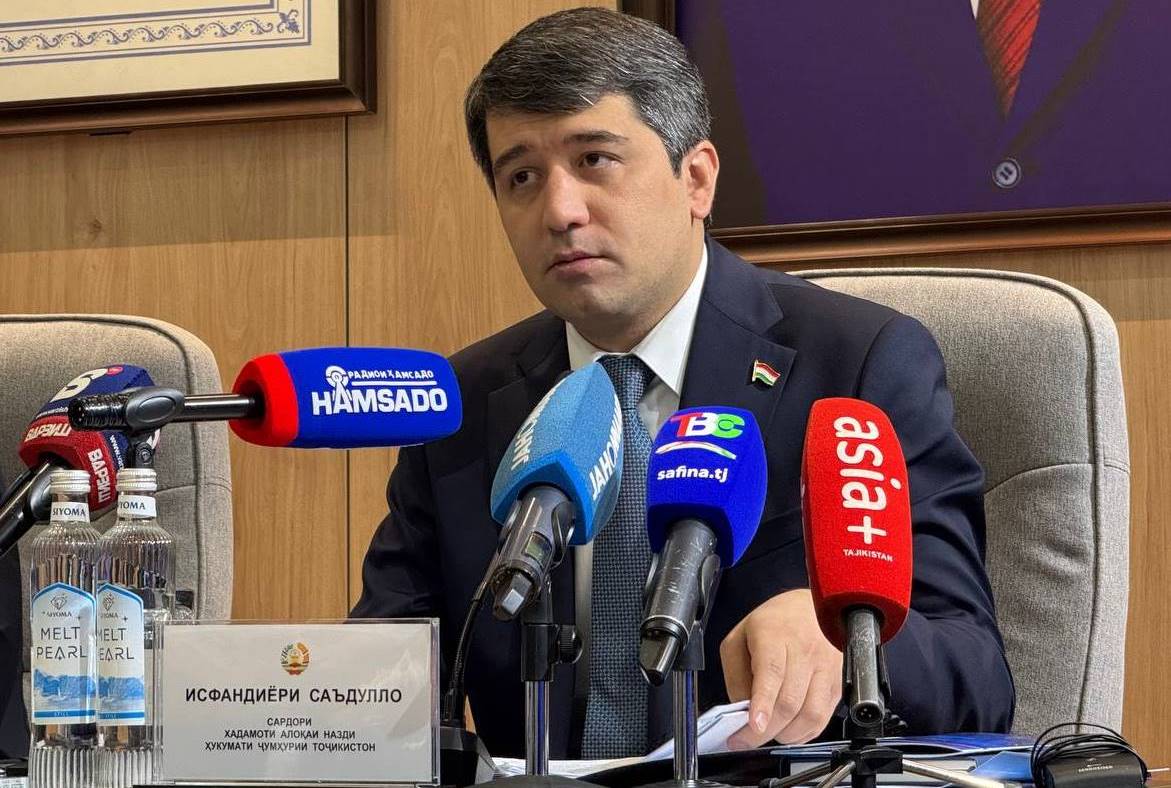
On January 28, 2025, the Communications Service of Tajikistan held a press conference addressing key issues surrounding internet quality, pricing, 4G and 5G coverage, mobile operator penalties, and the project for connecting internet from China.
Internet speed and pricing
According to the communications service agency, fixed internet speeds in Tajikistan were increased from 30 Mbps to 40.42 Mbps in 2025. The agency confirmed that efforts to improve internet speeds would continue, with a target to reach 100 Mbps in the next two years. Internet tariffs for fixed-line providers have dropped by an average of 55%, and plans with speeds below 30 Mbps have been discontinued. The cost of mobile and fixed internet has also decreased.
However, Isfandiyor Sa’dullo, Head of the Communications Service, stated that slow internet speeds remain a significant issue in mobile networks. He noted that "there are no serious issues with fixed-line internet, as its speed and quality meet modern requirements."
Plans for 4G and 5G coverage
The communications service agency head also revealed that by 2027, all of Tajikistan will be covered by 4G internet. The relevant instructions have already been sent to mobile operators. By 2030, Tajikistan plans to fully transition to 5G internet, with a 5G base station installation plan already approved for 2026–2030. According to this plan, base stations for the 5G standard will be installed in 65 cities and districts across the country in collaboration with mobile operators.
Currently, Tajikistan has 84 operational 5G base stations, with 77 located in Dushanbe, one in Roghun, one in Khorog, two in Bokhtar, and three in Khujand. "The performance of 5G is better than 3G and 4G, but not all mobile phones support this standard. Citizens with 5G-compatible devices are already using the service to its full extent," said Sa’dullo.
Strategy for 2040
Sa’dullo also mentioned that, under the President's instructions, the Communications Service has developed a draft "Communications Industry Development Strategy until 2040." The document is nearing completion and will soon be presented to the government. The strategy includes 16 key target indicators, such as achieving 100% broadband internet coverage, increasing the speed of fixed and mobile internet, expanding 4G and 5G coverage along highways, and improving public satisfaction with communications services.
Challenges with electricity supply
One of the reasons for the poor quality of mobile internet, according to the Communications Service, is the sharp increase in internet consumption. In the past five years, internet usage has grown tenfold—from 3 GB to 30 GB per user—leading to overloading of base stations.
Currently, there are 5.2 million users of mobile and fixed internet in the country (up from 4.5 million in 2024), with 5.1 million subscribing to mobile internet services. At present, 62% of base stations are equipped with diesel generators, and 8% are powered by solar panels. By 2026, the goal is to equip 80% of base stations with generators and 30% with solar panels.
Other issues facing the industry include outdated infrastructure and equipment, challenging geographical conditions, high loads on base stations, lack of investment, a shortage of qualified personnel, and power supply limitations. "Power supply restrictions do create difficulties, but it would be wrong to consider them the main problem. The key issue is the lack of modern infrastructure and new-generation base stations," Sa’dullo emphasized.
Tcell's Director-General, Ozodkhon Davlatshoyev, noted that one of the main challenges is the lack of a clear power outage schedule. "It is important for us to know in advance when and where the power outages will occur so that we can deliver fuel and start the generators on time. The problem is not with the fuel but with the notification system," he explained in response to journalists' questions.
Social media and oversight
During the press conference, Sa’dullo confirmed that social media in the country is under the control of the Communications Service. However, no decisions have been made regarding any restrictions on social media usage. "The technical capability for this exists, but currently, such measures are not being considered," he noted.
Internet connection from China
Regarding the project to connect internet from China, Sa’dullo stated that work has been temporarily suspended due to cold weather in the Murgab district. However, the connection line has already been extended to Khorog. They plan to resume work in March and complete the installation of the remaining 310 kilometers of fiber optic line by the end of 2026.
It is worth noting that the Communications Service had announced plans in September 2025 to connect internet from China, with plans to lay a fiber optic line with 48 fibers from Dushanbe to Khorog, and later extend it to the Chinese border.
Penalties for mobile companies
Sa’dullo revealed that in 2025, 129 administrative cases were filed against 119 individuals and legal entities for violations in the communications sector. The total amount of fines exceeded 400,000 somoni, with mobile companies being the main offenders, accounting for the majority of fines. "With the current level and quality of internet, avoiding fines is impossible," concluded Sa’dullo.