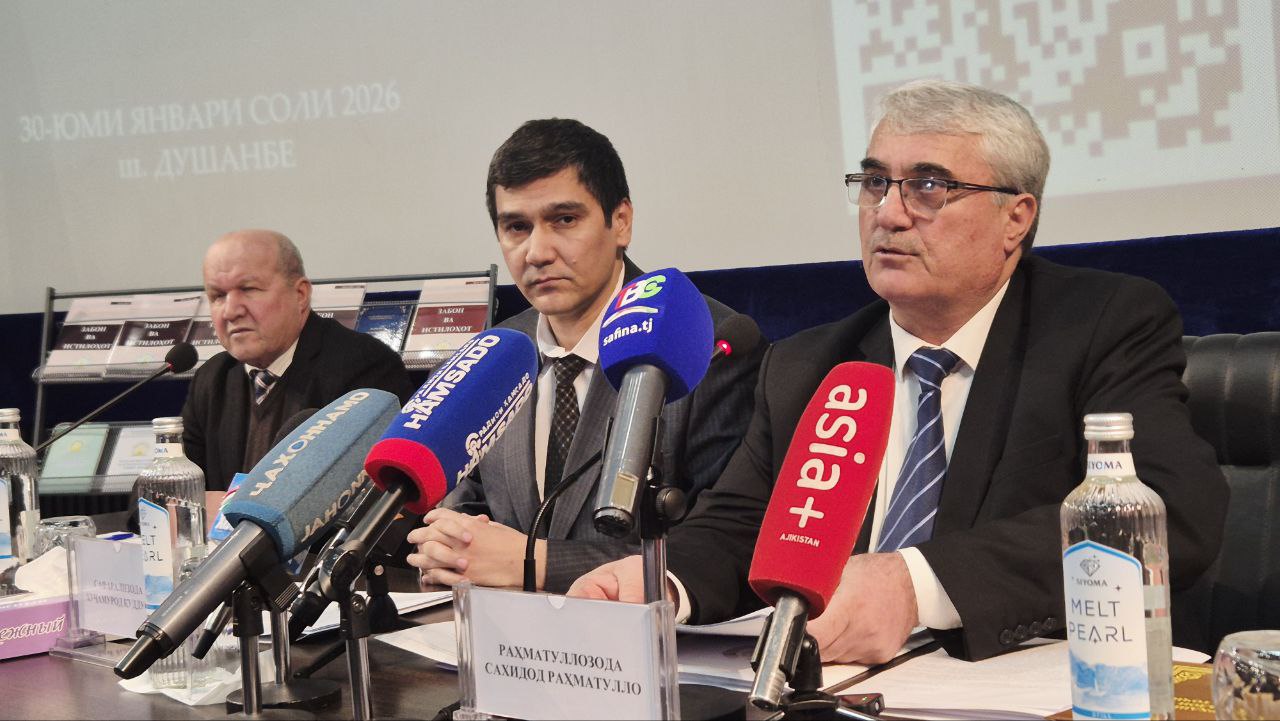
Giving children so-called “two-root” or “three-root” names is not prohibited in Tajikistan, Chairman of the Committee on Language and Terminology Sakhidod Rahmatullozoda told reporters in Dushanbe on January 30.
According to him, restrictions apply only to names that are considered inappropriate in sound, do not comply with the norms of the Tajik language, contradict national values, or promote the cultural values of other nations.
Rahmatullozoda noted that the issue of selecting Tajik names had been discussed at six meetings involving 35 linguists and academic experts.
Commenting on complaints from citizens about civil registry offices (ZAGS) refusing to register certain names, he stressed that “no one has denied the possibility of assigning two- or three-root names.”
To support his statement, the Committee chairman cited examples from the Dictionary of Tajik Names. In particular, 97 names are formed using the word “gul”, which is used only in combination with other words. The dictionary also includes 34 female names based on the word “dil.”
According to Rahmatullozoda, the dictionary lists 15 names containing “orio”, 19 with “pok”, 22 with “ozar”, 16 with “beh”, 40 with “moh”, 31 with “mah”, and 27 names with “mehr.” The choice of such names, he emphasized, is free.
At the same time, Rahmatullozoda reiterated that the Committee would take a strict stance against the promotion of non-Tajik names.
“Naming a child is a vital issue. We want our people to travel the world with national names, to have passports with our own names, and to live with them. Why should we be proud of other nations’ names? We must be proud of our national names,” he said.
Why certain words are removed from surnames
Responding to journalists’ questions about why words such as “sang,” “tabar,” “tesha,” and “khor” are being removed from inherited surnames, the Committee chairman explained that this practice is provided by the Law on the State Language, while the procedure is regulated by the Law on State Registration of Civil Status Acts.
He emphasized that every child has a constitutional right to a harmonious and appropriate name.
“There were cases when many children in a family were born and died, and in order for the next child to survive, they were given names like Sang or Khor. My own surname used to be Khorkashev, and my grandfather’s name was Khor. But why should a newborn suffer, having his constitutional right violated by being given an inappropriate and unpleasant-sounding name?” Rahmatullozoda said.
The issue of naming children has been widely debated in recent years, particularly after the introduction of state regulation in this area.
Residents claim that, despite the Tajik origin and conformity of their proposed names with national values, civil registry offices often refuse to register them, citing their compound structure.
The Committee chairman rejected these claims, though no clear criteria were presented for determining the acceptability of names consisting of two or more roots. Citizens are advised to consult the Dictionary of Tajik Names.