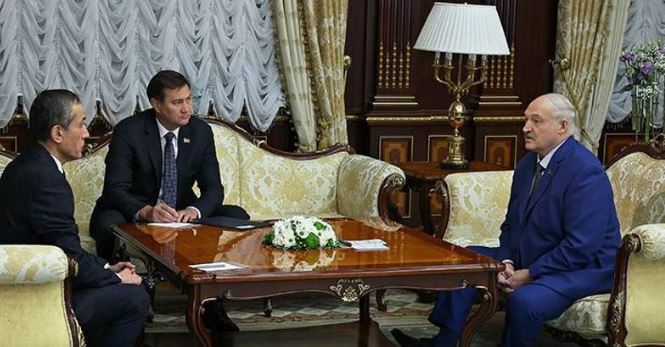
On March 9, Belarusian President Alexander Lukashenko held a meeting with Uzbekistan’s Ambassador to Belarus, Rakhmatulla Nazarov. The talks took place ahead of an upcoming visit by Uzbek President Shavkat Mirziyoyev to Belarus.
The sides discussed the development of bilateral cooperation, including plans to increase a two-way trade between the two countries to $2 billion by 2030.
Cooperation in nuclear energy was also discussed during the meeting. The Belarusian side expressed readiness to share its experience and specialists for the construction of a nuclear power plant in Uzbekistan. According to the Belarusian state-run news agency BelTA, particular interest is focused on the development of the town of Ostrovets, where Belarus’ nuclear power plant is located.
Lukashenko also confirmed that preparations are underway for President Mirziyoyev’s visit to Minsk.
The Belarusian leader additionally addressed the issue of labor migration. He said Belarus is ready to welcome migrant workers from Uzbekistan, especially those who plan to move together with their families.
“Many Uzbeks live in our country and want to live and work here. These are our people. We gladly invite them, especially families. Unfortunately, our population is not growing as fast as yours. Therefore, we are always happy to see hardworking Uzbek people if they decide to come here,” Lukashenko said.
He added that Belarus maintains a strict system for hiring migrant workers: foreigners are invited for specific jobs and provided with the necessary conditions for living and working.
According to Lukashenko, newcomers are given the same opportunities as citizens of Belarus and other countries.
“We hire people for specific jobs and provide all the necessary opportunities — childcare, kindergartens, schools, and higher education for their children. On equal terms with Belarusians, Russians, Ukrainians and others. Please come and compete,” he said.
Lukashenko also noted that during the Great Patriotic War of 1941-1945I many Belarusians found refuge in Uzbekistan.
“Many of our people found shelter in Uzbekistan, where they were treated with humanity. In that sense, we owe you something, although at that time we were living in one country,” he added.