St. Petersburg Mining Institute to open its branch in Tajikistan

DUSHANBE, December 14, 2009, Asia-Plus  — The G. V. Plekhanov St. Petersburg State Mining Institute and Technical University is expected to open its branch in Tajikistan. Noilsho Nouraliyev, a spokesman for the Ministry of Education (MoE), told Asia-Plus Monday afternoon that such an agreement was reached at a meeting of Tajik Prime Minister Oqil Oqilov […]

DUSHANBE, December 14, 2009, Asia-Plus  — The G. V. Plekhanov St. Petersburg State Mining Institute and Technical University is expected to open its branch in Tajikistan.

Noilsho Nouraliyev, a spokesman for the Ministry of Education (MoE), told Asia-Plus Monday afternoon that such an agreement was reached at a meeting of Tajik Prime Minister Oqil Oqilov with St. Petersburg governor Valentina Matviyenko that took place in St. Petersburg on September 11 on sideline of the next session of the Interstate Council of the Eurasian Economic Community (EAEC).

The G. V. Plekhanov St. Petersburg State Mining Institute and Technical University is Russia’s oldest higher education institute devoted to engineering.  Located in St. Petersburg, the institute is one of the oldest mining schools in Europe, and home to one of the world”s finest and most exclusive collections of minerals, gem samples and mining equipment miniatures used for teaching purposes.

The Institute was founded on October 21 OS/ November 1 NS 1773 by order of Empress Catherine II.  It was known as the Mining School until 1804 when it became the Mining Cadet”s Corps; in 1833, it became the Institute of the Corps of Mining Engineers.  Since 1866, it has been known as the Mining Institute.

During the Soviet period, it was renamed after Georgi Plekhanov, who attended the institute in the 1870s, and became known as “the G.V. Plekhanov Leningrad State Mining Institute and Technical University.”  Since 1869 the institute is the headquarter of the Russian Mineralogical Society. 
Join us on social media!

Article translations:

Related Article

Оби зулол
Оби зулол
Tenisi

Most Read

Коммерсбонк Точикистон

Recent Articles

President of Tajikistan instructed to develop measures for stabilizing the cement market within a week

Despite the increase in the production of this building material in the country, the domestic market faced a shortage, supply disruptions, and a sharp rise in the price of the building material.

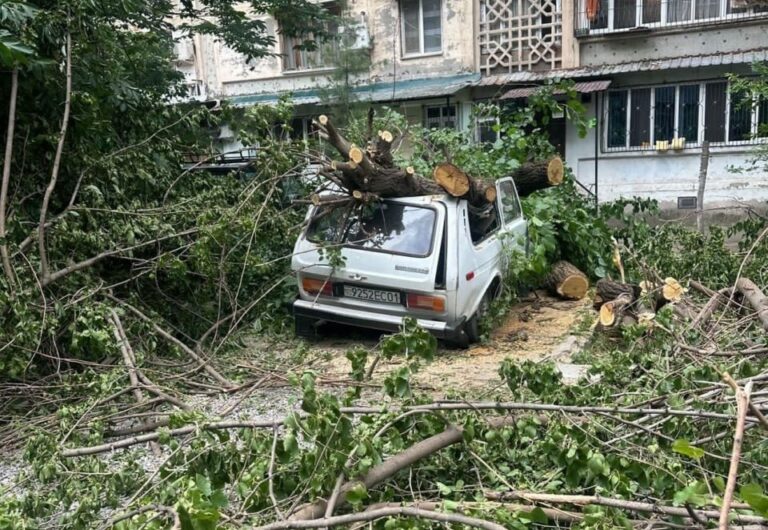
Gusty winds and mudslides damage houses, roads, and cars in Dushanbe and some other regions

At least 9 vehicles were damaged, including three in Dushanbe and six in Vahdat.

The US struck military facilities in Iran. Trump expressed dissatisfaction with Tehran’s proposals and threatened Oman.

Earlier, Iran's state TV reported receiving a draft unofficial framework agreement between Tehran and Washington to settle the conflict.

How much did Tajikistan’s budget earn from the “Google tax”?

The law is already 5 years old, but the Tax Committee provided data only for the last 2 years.

The bilateral trade between Tajikistan and Iran increased by 8% in Q1 2026

Another meeting of the joint intergovernmental commission of the two countries took place in Dushanbe.

Russia and Taliban government sign military-technical cooperation agreement

The document may open up opportunities for the exchange of weapons, military technologies, and other types of defense cooperation.

“Hit with fists on the lower back and abdomen.” A teacher from Nurobod, claiming he was beaten by a student’s brother, details the attack

According to him, he is being threatened with murder, and law enforcement agencies have not yet detained the attacker.

International internet starts coming back in Iran after long shutdown 

Western media reports says Iranians ​isolated by a long...

Tajikistan listed among countries with low generative AI usage

Among the Central Asian countries, Kazakhstan has the highest rate.

Prices in Tajikistan rise almost 2% in January-April: apples, fuel, and utilities become particularly more expensive

In April, inflation was 0.6%: food products became more expensive, non-food products increased in price comparatively less, and tariffs for paid services remained unchanged.