Landmines remain one of the most serious humanitarian and security challenges facing Azerbaijan today. Decades of conflict, particularly the First and Second Garabagh wars, have left vast areas contaminated with anti-personnel and anti-tank mines, as well as explosive remnants of war (ERW). These hidden dangers continue to threaten civilian lives, hinder economic development, and delay the safe return of internally displaced persons (IDPs).
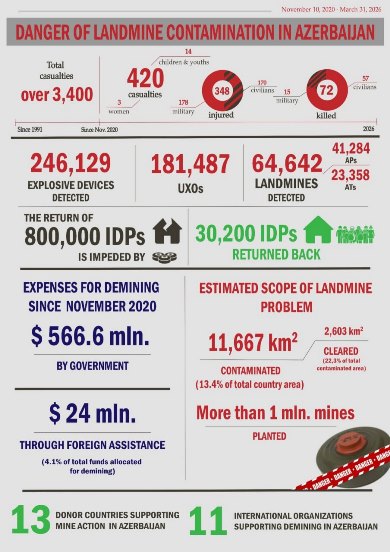
Azerbaijan is among the most heavily mine-contaminated countries. The latest survey indicates that total contaminated area in the liberated territories of Azerbaijan stands at approximately 11,667 square kilometres. This area constitutes more than 13.4% of the country’s total territory of 86,600 square kilometres. More than one million landmines and an unknown number of ERW contamination in these territories pose severe risks to civilians and hinder socio-economic development.
The humanitarian impact is severe. Since the end of active hostilities, numerous civilians and military personnel have been killed or injured by landmine explosions. From the end of war in 2020 until 31 March 2026, 258 landmine explosion incidents occurred, resulting in 420 victims, including children and women, underscoring the urgent need for mine clearance and victim assistance. Over the last 30 years, the cumulative toll of landmine victims in Azerbaijan has exceeded 3,400.
The end of war in 2020 marked the beginning of an extensive humanitarian demining in Azerbaijan to restore safety in the liberated territories, facilitating the reconstruction of these areas and the safe return of former internally displaced persons (IDPs). Foreign assistance has accounted for only 4.1% of the resources dedicated to demining. This is notably low, both in light of the gravity of demining challenges Azerbaijan confronts and when compared to the level of contributions typically made by the international donor community to similar issues elsewhere.
The lack of accurate minefield maps further complicates demining efforts, increasing both the time required and the risks faced by demining personnel. Victims often include returning residents, farmers, and workers involved in reconstruction projects. Beyond physical harm, landmines also create long-term psychological trauma and fear among affected communities.
Economically, the mine problem significantly slows reconstruction and development. The Azerbaijani government has launched large-scale projects to rebuild liberated areas, including roads, schools, and housing. However, before any construction can begin, land must be cleared of mines—a process that is both costly and time-consuming. As a result, the return of displaced populations is delayed, and economic activities such as agriculture remain limited.
Efforts to address the issue are ongoing. The Azerbaijan National Agency for Mine Action (ANAMA) plays a central role in demining operations, working alongside international partners and organizations. Advanced technologies such as drones, mine-detecting dogs, and mechanical demining equipment are being used to accelerate the process. Despite these efforts, experts estimate that it may take many years to fully clear the affected areas.
International cooperation is crucial in tackling this problem. Financial assistance, technical expertise, and increased global awareness can help speed up demining operations and reduce casualties.
Azerbaijan highly appreciates the support already provided by international partners in addressing the urgent challenge of landmine contamination. At the same time, the scale and complexity of the problem require increased and sustained practical assistance from the global community.
Enhanced international cooperation will not only help save lives but also facilitate the safe return of displaced populations, support post-conflict reconstruction, and promote lasting peace and stability in the region. Azerbaijan remains committed to working closely with its partners and expresses sincere gratitude for all forms of practical assistance aimed at overcoming this critical humanitarian challenge.
The landmine problem in Azerbaijan is a complex and long-term challenge with serious humanitarian, economic, and social consequences. While significant progress has been made, sustained efforts at both national and international levels are necessary to ensure a safer future and enable the full recovery of affected regions.