
Farrukh Umarov is the co-founder of the skill accelerator Ilmkhona and the project manager of Reskill, one of the tech startups developing in Tajikistan. In an interview with Asia-Plus, he talked about how the startup ecosystem is forming in the country, the challenges entrepreneurs face, and the opportunities available for young founders.
– This is not your first startup. You already have experience, including with Ilmkhona. What are the signs that indicate a startup will be successful?
– There is no definitive answer to this question: on average, only one out of ten startups becomes successful. But there are several important factors.
First and foremost is the team. It is important that the founders have a good understanding of the problem they are working on, have faced it themselves, and are motivated to solve it. Also important are their energy, persistence, and ability to find resources.
The second point is a unique insight into the problem. A startup should offer a solution that others have not yet seen.
The problem itself also plays a significant role: how serious it is and how often people encounter it. If it is a real pain that people are willing to pay to solve, the chances of success are higher.
And, of course, the result is important — the so-called traction. This means the product is already working, has users, and the team knows how to develop and sell it.
– Can you determine early on that a startup will fail? Are there signs that indicate this?
– Yes, there are such signs. One of the main ones is a lack of understanding of the market. When the founders have poorly studied the problem and do not fully understand how everything actually works.
The second point is a weak team. For example, when participants have no experience in the chosen field but are confident they understand everything. In reality, every industry has many hidden complexities.
Motivation is also important. If the founder lacks the internal energy and “fire” that others are willing to follow, it will be difficult to assemble a strong team.
Another critical factor is the lack of technical expertise. If the team does not understand how to create a product or lacks a technical specialist, this is a serious risk.
– How important is the environment in which a startup develops? Can the same idea succeed in one country and not work in another?
– Yes, the environment plays a very important role. It depends on the market, the level of technological development, the purchasing power of the audience, and other factors. Therefore, it is important to initially understand where exactly your product will be in demand and how ready the market is for such a solution.
Which startups should be launched?
– How suitable is Tajikistan for launching startups, and what needs to change for it to become a full-fledged market?
– I believe that startups in Tajikistan can and should be launched, but it is important to immediately think about entering other markets. The reason is that we have a small market, and any tech startup has a growth ceiling.
To change the situation, it is important to focus on local problems unique to Tajikistan and create solutions specifically for them. It is also necessary to improve conditions for entrepreneurs by simplifying processes and reducing administrative barriers.
For example, “sandboxes” can be developed within IT parks where startups can test ideas without immediately thinking about business registration, taxes, and other formalities.
If there are still restrictions in the country and it is difficult to do business, entrepreneurs will seek opportunities abroad — in more developed and convenient ecosystems.
Photo. Training courses from Ilmhona — another brainchild of Farrukh Umarov. Photo Ilmhona
– Which startups will be the most promising to launch in Tajikistan in the next 5 years?
– Primarily, fintech. There are already successful examples in Tajikistan: Alif, Humo, Zypl, Planet9. However, the country still remains a “cash country,” where cash is widely used, and bank cards are not accepted everywhere. This means fintech has great potential for development, especially in the field of digital payments.
Agritech is also a promising direction. Agriculture remains one of the key sectors of Tajikistan’s economy, and the introduction of technologies here can have a significant effect.
– How promising are education and artificial intelligence?
– Educational technologies (EdTech) are an important and noble direction, but they do not always bring quick financial results. Therefore, entrepreneurs need to understand if they are ready to work in this field with a long-term perspective.
As for artificial intelligence, it will not be a separate industry but will become part of all directions. Practically every startup in the future will use AI as a tool.
Additionally, new directions can be considered, such as Spacetech – not in terms of creating rockets but in the field of research and technology.
The main thing is not only the presence of a problem in the market but also its monetization potential. Not every idea, even if it is useful, can become a successful business.
“Our goal is to remain a driver of the educational environment’s development”
– Ilmkhona is often called a startup, although it is an NGO. Which organizations have made key contributions to its development?
– Thank you, it’s very nice to hear that Ilmkhona is well-known — it shows that we are moving in the right direction.
I would describe Ilmkhona as a Neo-NGO — a new format of an NGO. We don’t just live from grant to grant, as is often the case, but work with a clear mission — to inspire and transform the young generation in the field of technology.

We collaborate with international organizations and partners who value skill development and job creation. With their support, we subsidize the cost of training. For example, the actual cost of courses can be around $1500, but for students, it becomes affordable thanks to grants.
Moreover, we are developing new directions. For example, the Reskill project is a commercial product focused on corporate training. With its help, educational programs can be quickly created using technologies, including content generation and employee training.
We are also working on simplifying course creation within Ilmkhona — up to the point of creating them in a short time using new technologies, including AI solutions and multilingual tools.
Our goal is not only to educate but also to constantly implement new approaches and technologies, remaining one of the drivers of the educational environment’s development in the country.
– Tell us about the EBRD Star Venture program. How did you get involved, and what support did you receive?
– EBRD Star Venture is an acceleration program by the EBRD for fast-growing startups from participating countries. We applied last year, went through several stages of selection, including interviews and document submission, and eventually became one of the top five startups from Tajikistan. This was the first time the program was launched in the country, and we became its first participants.
– What does the program’s support entail?
– It’s not grant support — startups do not receive direct funding. The program provides so-called in-kind support: consultations, mentorship, and access to experts in various fields — from marketing to technology.
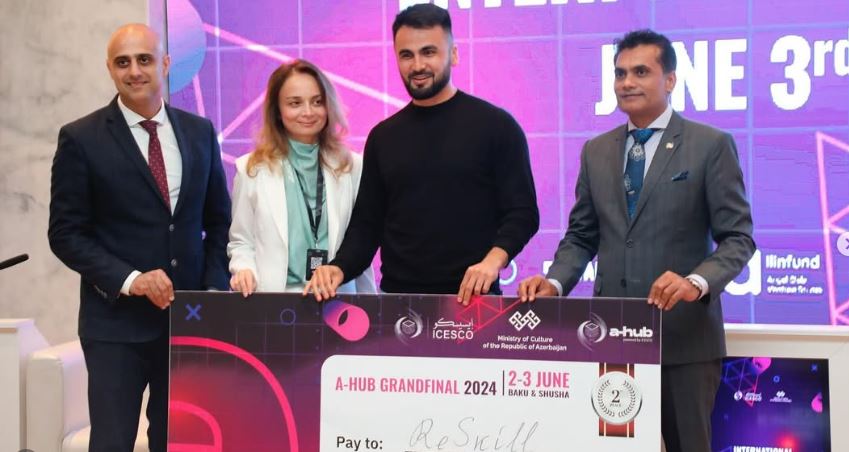
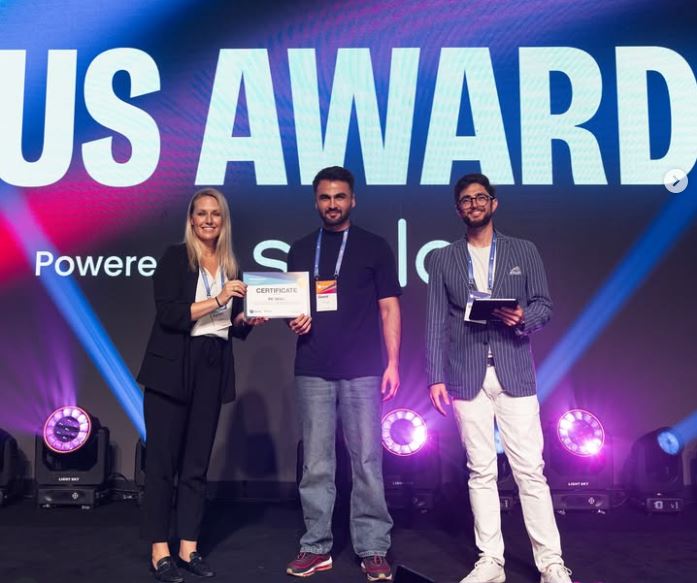
Additionally, participants are given the opportunity to attend international conferences. For example, we have already participated in Web Summit, Biban in Saudi Arabia, STEP in Dubai, and Baku ID in Azerbaijan, where we received the “B2B Startup of the Year” award.
These trips are important not only for the experience but also for networking, finding partners, and investors.
Overall, the program helps to develop much faster by providing access to expertise, an international network, and new opportunities.
“It’s not enough to just launch a startup”
– Why don’t all startupers strive to participate in such programs?
– There are several reasons. First, it’s a lack of awareness. Many simply do not know about such programs and do not understand what benefits they can gain.
But there’s a deeper reason — it’s about the environment and mentality. In Tajikistan, in general, there aren’t many startups. That’s why we launched the Founder School program — to form a new generation of founders. We work not with ideas but with people: teaching them to create startups, developing mindset and skills.
Essentially, we are trying to build a complete ecosystem: first — people ready to launch projects, then — incubation and acceleration programs where ideas and business models are refined.
The second important reason is the level of risk. Many do not have a “safety net.” Unlike other countries, here people take on responsibilities early — family, work, obligations. Not everyone has the opportunity to experiment and try themselves in startups for several years.
Therefore, for many, the choice is obvious: stable income today or a 10% chance of success in the future. And not everyone is willing to take the risk.
The third reason is a lack of understanding of the term “startup” itself and its potential. Many do not see the difference between a regular business and a tech startup and do not understand what opportunities it opens up — both inside the country and beyond.
As a result, people often choose familiar and understandable income, not realizing the scale of potential opportunities. Therefore, it is important not only to create programs but also to promote them better and explain their value.
It’s not enough to just launch a startup, but you also need to talk about it, spread information about it, so that people know you exist.
– What three pieces of advice would you give to aspiring startupers from Tajikistan?
– First, do not be afraid. Do not be afraid to dream and set ambitious goals. Honestly, one of my regrets is that I didn’t start Ilmkhona on a larger scale right away. However, I am proud of what we are doing now and our team. But it’s important to initially think bigger and not limit yourself.
The second piece of advice is to choose the right team. Building a startup alone is very difficult, but with the wrong people, it’s even harder. Therefore, it is important to surround yourself with people who share your values and are ready to go with you to the end.
The third piece of advice is to start communicating with your potential users as early as possible. If you have an idea, go and test it. Go to people, tell them, show them, watch their reaction. Do not rely solely on your internal feeling that “the idea is great.” You need to test hypotheses in practice.
Even if the product is not ready yet, it’s better to give people the opportunity to use it and get feedback. This will help you understand if your product solves a real problem. If yes, it’s worth moving forward and investing time and resources. If not, it’s better to change direction in time.
And, perhaps, a bonus tip — do not take all advice indiscriminately. It’s important to listen, but ultimately think for yourself and make your own decisions.
Don’t give up. Think for yourself. Remember the past
– We could wrap up here, but we have one more section — a quick round. We’ll ask short questions, and it’s preferable to answer them quickly and without much thought. I’ll ask 10 questions.
A book every young person in Tajikistan should read?
– “The Republic” by Plato.
– What do you miss most about Tajikistan when you’re abroad?
– The mountains.
– The best advice you’ve ever received?
– Think for yourself.

– What personal principle helps you cope with difficulties?
– Don’t give up and remember your past.
– An educational startup in the world you admire?
– Sana.
– What did you dream of becoming when you were a child?
– A prosecutor.
– If you had one day free from work and projects, how would you spend it?
– Surfing.
– In which city would you like to live for at least six months?
– For some reason, London. Let it be London.
– What does success mean to you?
– Inner peace and lack of anxiety.
– Artificial intelligence in education in 10 years — more of a benefit or a risk?
– Benefit.