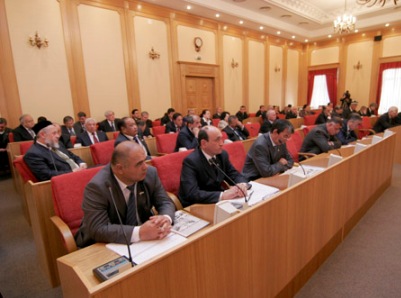
DUSHANBE, July 21, 2011, Asia-Plus — Members of Tajikistan’s upper chamber (Majlisi Milli) of parliament have unanimously seconded the law on holding parents responsible for their children’s action and education.
The next session of the Majlisi Milli, presided over by its head, Mahmadsaid Ubaidulloyev, was held in Dushanbe on July 21.
Presenting the parental responsibility law, Tajik State Medical University Chancellor Ubaydullo Qurbonov noted that commotion raised by some media outlets and representatives of civil society over the law were absolutely unfounded.
“Article 14 of this law that regulates relations of the rising generation with religious associations does not infringe upon rights of children; on contrary it protects them, Qurbonov said.
The draft law on holding parents responsible for their children’s action and education, submitted to the parliament by President Emomali Rahmon, was approved by the lower house (Majlisi Namoyandagon) of parliament on June 15.
It must still be signed by the president before going into effect.
We will recall that in a statement delivered in Vienna on Tajikistan’s Parental Responsibility Law, Acting Political Counselor at the United States Mission to the OSCE, Patrick Connell, noted on June 23 that the law grants the state power to interfere in family life and includes a ban on youth participation in religious communities, with very limited exceptions. If the ban is signed into law, it would effectively deny the right to worship to millions of citizens of Tajikistan under the age of 18, Mr. Connell said.
In an interview with Radio Liberty’s Tajik Service, Tajik prominent politician and religious leader Hoji Akbar Turajonzoda on June 17 criticized the parental responsibility law as being openly against the will of God. Hoji Akbar Turajonzoda told RFE/RL that under the legislation, parents whose underage children are caught attending prayers would be held legally responsible for allowing them to do so. Turajonzoda also criticized an amendment to Tajikistan”s criminal code approved by parliament on June 15 that makes the opening of illegal religious schools punishable by between five and 12 years in jail. Previously, running such illegal schools incurred only an administrative punishment or a fine.