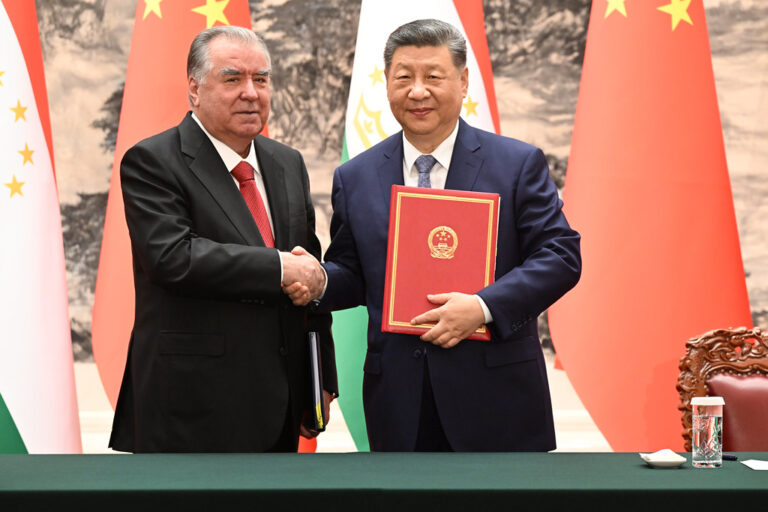
DUSHANBE, April 30, Asia-Plus – President Emomali Rahmon on April 27 met with visiting United Nations High Commissioner for Human Rights, Louise Arbour.
Speaking to journalists after a meeting with President Anomaly Rahmon, Ms. Arbour said that one of the main purposes of her visit was to discuss the establishment of a Regional Office for Central Asia that will be located in Bishkek, Kyrgyzstan.
On the present human rights situation in Tajikistan, the UN Rights Commissioner reminded that Tajikistan had ratified the main human rights conventions and pacts and with support of the United Nations the country had succeeded in submission of reports on fulfillment of its obligations on those major human rights instruments. She also positively assessed the death penalty moratorium, which is in effect in Tajikistan.
According to her, the main difficulty today consists in the practical fulfillment of recommendations of the human rights treaty bodies.
“During the meeting, we also discussed issues related to reforms in the judicial system of Tajikistan. I expressed my concern about a state of the country’s judicial sector,” said the High Commissioner, “I noted that it is necessary to carry out reforms to improve the Criminal-Procedural Code.”
Besides, Ms. Arbour expressed concern about state of overseeing penitentiary institutions in the country and poor conditions both in pretrial detention facilities and penal colonies. “I think the judicial bodies should be involved in the case of overseeing the penitentiary institutions and independence of the judicial system should be strengthened,” said Arbour, “I also brought to President Rahmon’s attention the issue of providing access to the penitentiary institutions for local and international monitors, including the International Committee of for Red Cross.”
According to her, she solicited and convinced the president of setting up independent human rights institution insistently that would operate on the basis of the Paris Principles.
“Besides, it is important for Tajikistan to join Optional Protocol to the Convention against Torture, which provides a framework for monitoring places of detention,” Arbour said.
Asked about her attitude to ban on headscarves for university students in Tajikistan, the High Commissioner noted that this issue has been discussed in some countries – France, the Great Britain and Canada. “As far is the issue of the human rights is concerned, a process of discussion is probably more important than the result,” she noted. “And it is important that the issue should be considered on the basis of tolerance and respect for different groups of the population.”
Commenting on the issue of why she did not visit Uzbekistan, the UN Rights Commissioner noted that authorities of that country had not refused her visit to Uzbekistan. According to Arbour, when they were organizing the tour of countries in Central Asia, the governments of four countries gave their consent, while Uzbekistan’s government told her office that “days of visit are not suitable for it.”