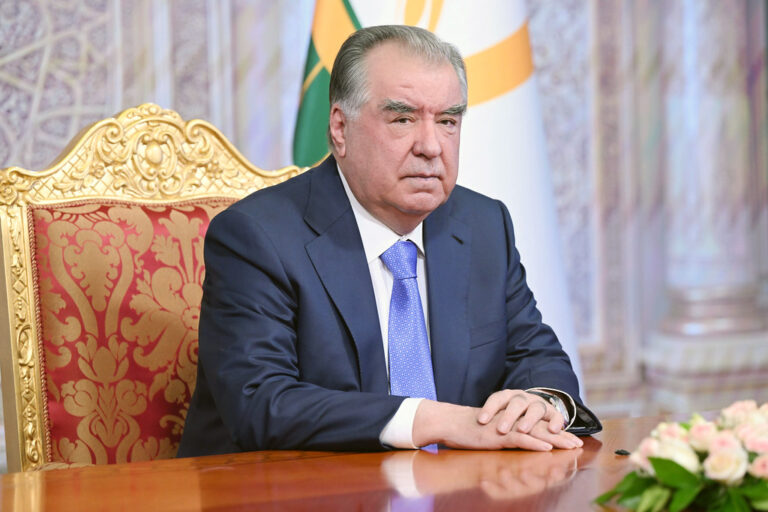
DUSHANBE, February 12, 2009, Asia-Plus — On February 11, President Emomali Rahmon met in Brussels with the Energy Charter Secretary General Andre Mernier.
According to presidential press service, the two discussed issues related to supporting Tajikistan’s scientific-technical power projects and establishing bilateral cooperation in exploring and developing oil and gas as well as coal deposits.
Rahmon and Mernier also discussed establishment of hydropower department at the Energy Charger to which Tajikistan would appoint its permanent representative.
Yesterday, President Rahmon also attended a ceremony of opening of a new building of Tajik Embassy in Brussels and a business forum of Tajik and Belgian entrepreneurs, the press service said.
The roots of the Energy Charter date back to a political initiative launched in Europe in the early 1990s, at a time when the end of the Cold War offered an unprecedented opportunity to overcome previous economic divisions. In a world of increasing interdependence between net exporters of energy and net importers, it is widely recognized that multilateral rules can provide a more balanced and efficient framework for international cooperation than is offered by bilateral agreements alone or by non-legislative instruments. The Energy Charter Treaty therefore plays an important role as part of an international effort to build a legal foundation for energy security, based on the principles of open, competitive markets and sustainable development.
The Energy Charter Treaty and the Energy Charter Protocol on Energy Efficiency and Related Environmental Aspects were signed in December 1994 and entered into legal force in April 1998. To date, the Treaty has been signed or acceded to by fifty-one states, the European Community and Euratom (the total number of its members is therefore fifty-three).
The Treaty was developed on the basis of the 1991 Energy Charter. Whereas the latter document was drawn up as a declaration of political intent to promote energy cooperation, the Energy Charter Treaty is a legally-binding multilateral instrument. The fundamental aim of the Energy Charter Treaty is to strengthen the rule of law on energy issues, by creating a level playing field of rules to be observed by all participating governments, thereby mitigating risks associated with energy-related investment and trade.