Tajikistan adopts law banning use of cell phones at high schools

DUSHANBE, March 10, 2009, Asia-Plus  – Deputies of the Majlisi Namoyandagon (Tajikistan’s lower chamber of parliament) have endorsed the bill putting a ban on the use of cell phones at high schools. A regular sitting of the fifth session of the Majlisi Namoyandagon of the third convocation, presided over by its chairman, Saydullo Khairulloyev, was […]

Avaz Yuldoshev

DUSHANBE, March 10, 2009, Asia-Plus  – Deputies of the Majlisi Namoyandagon (Tajikistan’s lower chamber of parliament) have endorsed the bill putting a ban on the use of cell phones at high schools.

A regular sitting of the fifth session of the Majlisi Namoyandagon of the third convocation, presided over by its chairman, Saydullo Khairulloyev, was held on March 10.

Parliamentarians considered and approved a number of amendments made to the country’s laws on education, higher and post-graduate vocational education and basic vocational education.

Presenting the bill requiring amendments to the mentioned laws, MP Dodikhudo Saymuddinov noted that the amendments concerned putting ban on the use of cell phones at high schools irrespective of forms of property.  “The ban applies to teachers as well,” Saymuddinov said.

According to him, the amendments resulted from president’s numerous addresses and are aimed at improving quality of the education process.  “The education minister’s order on the ban of the use of cell phones has not yielded proper results, and therefore, time has come to take legislative measures,” the parliamentarian said

We will recall that President Emomali Rahmon in March 2007 ordered the ban on the use of cell phones and private cars at high schools.

Those who break the law will have to pay a fee in accordance with the provisions of the country’s administrative code, Saymuddinov said.

In the meantime, speaking at the meeting, MP Yusuf Ahmadov noted that many parents used cell phones to control their children.  “If there is necessity for adoption of such amendments, it is necessary to install public telephones at all schools in order that parents would know where their kids are,” Ahmadov said.

He also noted that the most serious problem that was currently facing the education sector in the country was an acute shortage of teachers.  “Instead of tackling this serious problem, we have discussed the use of cell phones at educational facilities,” Ahmadov said.

By the majority of votes, parliamentarians approved the amendments.
Join us on social media!

Article translations:

Related Article

Оби зулол
Tenisi
Оби зулол

Most Read

Коммерсбонк Точикистон

Recent Articles

Tajikistan to transfer rural water utilities to a unified digital platform

The task is to integrate all 500 drinking water supply organizations in the country into one system.

Dushanbe authorities tighten price controls ahead of the Eid al-Adha holiday

Briefings and explanatory discussions are being conducted with vendors in the capital's markets, and violators face administrative protocols.

Major global investment companies show interest in Tajikistan’s economy

Among them are J.P. Morgan, Loomis Sayles & Company, Morgan Stanley Investment Management, and Global Evolution.

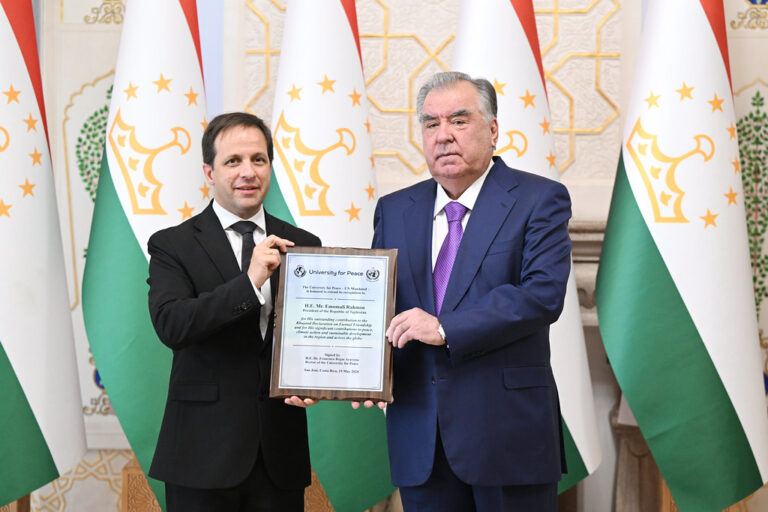
President Rahmon awarded UN University for Peace Certificate of Recognition

He is awarded for "significant contribution to establishing peace, developing regional cooperation, and strengthening mutual understanding between peoples."

Starlink satellite internet becomes available in Kyrgyzstan

And in Tajikistan, it was launched in February of this year.

In Dushanbe, 30 more new electric buses start operating

Each is designed to carry 100 passengers and can travel up to 300 kilometers without recharging.

Who is the man who “increased the Aryan race” and told the President of Tajikistan about it?

Kozie Koziyev, a folk craftsman, built dozens of houses, participated in the construction of a mosque and a kindergarten in Matcha, raised 11 children, and created a true dynasty of builders.

Tajik leader discusses water, climate, and global security issues with UN Deputy Secretaries-General

The parties paid special attention to the "Dushanbe Water Process," parliamentary diplomacy, and the peaceful resolution of conflicts.

Tajikistan completes the spring military draft target ahead of schedule

There is still a week left until the end of the conscription campaign.

Custodian of non-written languages and builder of academic bridges; philologist Khusrav Shambezoda turns 70

He could have devoted himself exclusively to the study of classical heritage, but he chose the challenging path of preserving the living word — and Tajik-Russian science gained in him a brilliant sociolinguist whose name became synonymous with dedication.