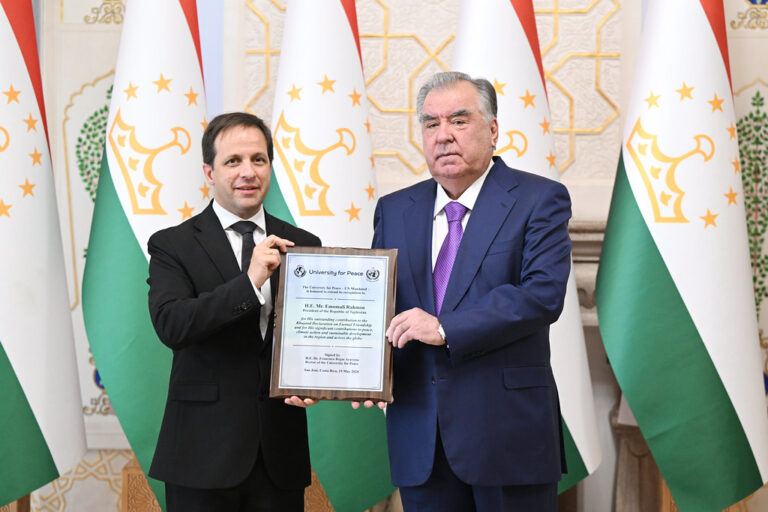
DUSHANBE, June 3, 2009, Asia-Plus — Issues related to state of ethnic minorities living in in Tajikistan as well as observance of their rights were the focus of a meeting of President Emomali Rahmon with visiting OSCE High Commissioner on National Minorities, Ambassador Knut Vollebaek, in Dushanbe on June 2.
Speaking to reporters after the meeting with President Rahmon, Ambassador Vollebaek noted that the OSCE intended to organize Tajik language courses for ethnic communities living in Tajikistan in the near future.
According to him, President Rahmon informed him of ethnic minorities living in the country, their traditions and cultures as well as problems facing them.
The OSCE High Commissioner on National Minorities also noted that the Organization for Security and Cooperation in Europe would protect the right of Tajik living outside to be educated in their native language, develop culture and publish books.
He also noted that he had also held talks with Foreign Minister Hamrokhon Zarifi and would meet with Culture Minister Mirzoshorukh Asrori, Education Minister Abdujabbor Rahmonov as well as representatives of ethnic communities on Wednesday.
Ambassador Knut Vollebaek was appointed to the post of High Commissioner on National Minorities of the Organization for Security and Cooperation in Europe (OSCE) for a three-year term on 4 July 2007, succeeding Mr. Rolf Ekeus of Sweden.
The post of the OSCE High Commissioner on National Minorities was established in 1992 to identify and seek early resolution of ethnic tensions that might endanger peace, stability or friendly relations between OSCE participating States.
The High Commissioner”s task is to provide “early warning” and, as appropriate, “early action” at the earliest possible stage “in regard to tensions involving national minority issues which have not yet developed beyond an early warning stage, but, in the judgement of the High Commissioner, have the potential to develop into a conflict within the OSCE area”.
The HCNM thus has a twofold mission: first, to try to contain and de-escalate tensions and, second, to act as a “tripwire,” meaning that he is responsible for alerting the OSCE whenever such tensions threaten to develop to a level at which the High Commissioner cannot contain them with the means at his/her disposal.