WB: Rising prices are re-emerging as threat to social stability in the poorest countries

DUSHANBE, February 17, 2011, Asia-Plus — According to new World Bank group numbers, rising food prices have driven an estimated 44 million people into poverty in developing countries since last June as food costs continue to rise to near 2008 levels. “Global food prices are rising to dangerous levels and threaten tens of millions of […]

Zarina Ergasheva

DUSHANBE, February 17, 2011, Asia-Plus — According to new World Bank group numbers, rising food prices have driven an estimated 44 million people into poverty in developing countries since last June as food costs continue to rise to near 2008 levels.

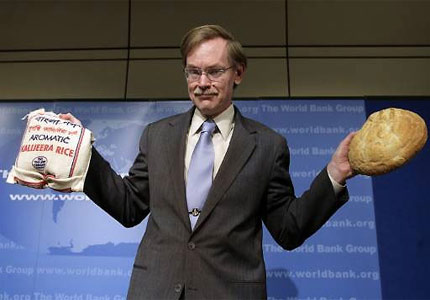
“Global food prices are rising to dangerous levels and threaten tens of millions of poor people around the world,” said World Bank Group President Robert B. Zoellick. “The price hike is already pushing millions of people into poverty, and putting stress on the most vulnerable, who spend more than half of their income on food.”

According to the latest edition of Food Price Watch, the World Bank’s food price index rose by 15 percent between October 2010 and January 2011, is 29 percent above its level a year earlier, and is only 3 percent below its 2008 peak, when surging costs sparked riots in more than a dozen countries.

Among grains, global wheat prices have risen the most, doubling between June 2010 and January 2011.  Maize prices are about 73 percent higher.  Sugar and edible oils have also gone up sharply.  But crucially for many of the world’s poor, rice prices have increased at a slower rate than other grains, the World Bank said.

According to Food Price Watch, the increase in extreme poverty (under US$1.25 a day) due to the price hike is associated with higher malnutrition, as poorer people eat less and are forced to buy food that is both less expensive and less nutritious.

The World Bank expects volatile, higher than average grain prices until at least 2015.  In the poorest countries, where people spend up to two-thirds of their daily income on food, rising prices are re-emerging as a threat to global growth and social stability.

The World Bank warns some nations may make the mistake of imposing curbs on shipments.  According to Bloomberg Television, Mr. Zoellick noted “If we don’t get a relief on the weather side, then I foresee conditions getting worse, and mistaken policy actions such as exports bans or other tax or price controls will exacerbate the problems.”  Trade curbs were a feature of the 2008 spike in food prices, when India and Vietnam were among nations that restricted or suspended shipments.

World Bank Group President calls on all countries to provide wide public access to information about quality and quantity of national grain reserves.  

Article translations:

Related Articles

Оби зулол

Most Read

Join us on social media!

Recent Articles

Emomali Rahmon accepted the credentials from new ambassadors

Nine countries have sent new diplomats to Tajikistan.

Russia evacuated 27 Tajikistan citizens from Iran

They worked at the Bushehr nuclear power plant, built by the Russian Federation in Iran.

Baku to host WUF13: shaping the future of sustainable urbanization

Baku, the capital of Azerbaijan, is set to host...

How the Energy Industry Began in Tajikistan 100 Years Ago

We have prepared a historical photo series for you.

Tajikistan and Belarus to establish a joint laboratory for radiation monitoring and nuclear safety

An agreement was signed by the Tajikistan Agency for Nuclear and Radiation Safety and the Belarusian National Technical University.

Former Press Secretary of Emomali Rahmon Sent a Letter to the President Requesting Support for Media Workers

Zafar Sayidzoda believes it is necessary to establish a Media Support Fund, which should operate in the interests of all media — both state and private.

Neither War nor Peace: What Will Be the Next Step for Iran and the US After the Failure of Negotiations?

Tajik experts say that Iran has another leverage that could pose a serious threat to the Trump administration.

In Dushanbe, a criminal group issuing SIM cards and bank cards to fictitious persons was exposed

Through illegally issued plastic cards, the suspects were withdrawing money from an online casino game.

The eKhonish program, an analogue of eDonish, launched in Bokhtar

Now parents and education representatives will be able to remotely monitor students' attendance and academic performance.

#AP30/Experts. Rashid Ghani Abdullo: “Asia-Plus” has become a brand of Tajikistan

A well-known Tajik political scientist expressed his opinion on the role of our media in the informational space of the country and the region.