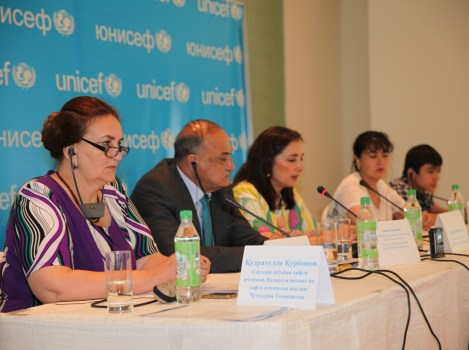
DUSHANBE, June 4, 2013, Asia-Plus — UNICEF launches its Flagship Publication “State of the World’s Children’s” (SOWC) report in Tajikistan. This year, the report reportedly focuses on Children with Disabilities (CWD).
According to UNCIEF CO in Tajikistan, the launching of the SOWC report follows the commemoration of the International Children’s Day, which this year also highlighted issues associated with disability.
The event will be attended by representatives of the relevant Government ministries, diplomatic missions, international organizations, disabled people’s organizations, the coalition of associations of parents of children with disabilities, as well as children with disabilities.
According to the UNICEF SOWC Report 2013, CWD are among the most marginalized people in the world. In general, CWD are less likely to receive health care or go to school and are among the most vulnerable to violence, abuse, exploitation and neglect, particularly if they are hidden or put in institutions because of the social stigma or the economic cost of raising them. Gender is also a key factor, as girls with disabilities are less likely than boys to receive food and care.
In Tajikistan, 26,345 CWD (up to 18 years of age) are receiving disability assistance from the Government and approximately 2,000 of them live in public residential care facilities, including special boarding schools. Given the international prevalence estimates of childhood disability the actual number of CWD could be much higher. This may be a result of the existing stigma in the community that “causes” parents to “hide” their CWD.
“We should see in every child a wealth of ability and enable them to engage and equally participate in the daily lives of their families, communities and societies. Concentrating on the abilities and potential of children with disabilities would create benefits for society as a whole”, said Ms. Laylee Moshiri, UNICEF Representative in Tajikistan.
Commenting on the release of UNICEF flagship publication, the UNICEF Representative called on the Government to ratify the Convention on the Rights of People with Disabilities and fully implement the Convention on the Rights of the Child to address the key challenges. She also emphasized that stigma can be reduced by promoting family and community-based care, and inclusive education that are backed by sufficient resource allocation and supported by social protection guarantees.
The State of the World`s Children 2013, which focuses on CWD, finds that the key to children with disabilities surviving and thriving is for them to have access to adequate services from the earliest years, grow up in caring families and to study in their local schools.
The State of the World`s Children report outlines ways for governments, the private sector, international donors and agencies, parliamentarians and other stakeholders to advance this agenda through strong partnerships. It renews the call for all governments to sign, ratify and effectively implement the Convention of the Rights of Persons with Disabilities (CRPD), including to:
– Dismantle all barriers to inclusion. This requires a change of perception: recognizing that children with disabilities` active presence and voice will not only help them but improve society as a whole as it gives everyone greater appreciation of diversity and tolerance.
– Generate reliable and comparable data needed to guide planning and resource allocation that realizes the rights of and the inclusion of all children. Society cannot be equitable unless all children are included and children with disabilities accounted for and rendered visible and active members of their own communities.
– End the institutionalization of children with disabilities with a moratorium on new admissions. UNICEF and governments are supporting families to prevent separation and end placement of children under three in large-scale institutions.
– Ensure that children with disabilities are identified as soon as possible and receive essential services so that that they are able to reach their full potential. Evidence confirms that the youngest age group (0-3 years) of children with disabilities lack access to specialist care and services in many countries of the region.
– Guarantee the right for all children to go to their local schools so that children, with and without disabilities, attend the same classes with additional, individually tailored support as needed.