CSTO foreign ministers make statements on Afghanistan and Syria

DUSHANBE, April 4, 2014, Asia-Plus — Presided over by Russian Foreign Minister Sergei Lavrov, a meeting of the Collective Security Treaty Organization (CSTO) Foreign Ministers’ Council took place in Moscow on April 3. The meeting reportedly focused on the situation in the CSTO area of responsibility. The meeting participants considered it expedient to intensify work […]

Payrav Chorshanbiyev

DUSHANBE, April 4, 2014, Asia-Plus — Presided over by Russian Foreign Minister Sergei Lavrov, a meeting of the Collective Security Treaty Organization (CSTO) Foreign Ministers’ Council took place in Moscow on April 3.

The meeting reportedly focused on the situation in the CSTO area of responsibility.

The meeting participants considered it expedient to intensify work on establishing thorough cooperation with the Shanghai Cooperation and expanding contacts with Afghanistan’s leadership both at the national level and at the level of border areas.

The CSTO foreign ministers made statements regarding the aggravation in northwest Syria and on Afghanistan ahead of the presidential election scheduled for April 5.

They are also approved a plan for holding consultations on foreign political cooperation, security and defense relations.

The CSTO foreign ministers also signed a number of the previously agreed instruments.

The CSTO Foreign Ministers Council is a charter body of the organization which holds sessions twice a year: in the run-up to a session of the Collective Security Treaty Organization (the end of the calendar year) and in between sessions (second quarter).  The meeting of the council in between sessions is organized in the state which holds the CSTO chairmanship.

The regional security organization was initially set up in 1992 in a meeting in Tashkent and Uzbekistan once already suspended its membership in 1999.  However, Tashkent returned to the CSTO again in 2006 The regional security organization was initially formed in 1992 for a five-year period by the members of the CIS Collective Security Treaty (CST) — Armenia, Kazakhstan, Kyrgyzstan, Russia, Tajikistan, and Uzbekistan, which were joined by Azerbaijan, Georgia, and Belarus the following year.  A 1994 treaty reaffirmed the desire of all participating states to abstain from the use or threat of force, and prevented signatories from joining any “other military alliances or other groups of states” directed against members states.  The CST was then extended for another five-year term in April 1999, and was signed by the presidents of Armenia, Belarus, Kazakhstan, Kyrgyzstan, Russia, and Tajikistan.  In October 2002, the group was renamed as the CSTO.  Uzbekistan that suspended its membership in 1999 returned to the CSTO again in 2006 after it came under international criticism for its brutal crackdown of antigovernment demonstrations in the eastern city of Andijon in May 2005.  On June 28, 2012, Uzbekistan announced that it has suspended its membership of the CSTO, saying the organization ignores Uzbekistan and does not consider its views.  The CSTO is currently an observer organization at the United Nations General Assembly.
Join us on social media!

Article translations:

Related Article

Оби зулол
Tenisi
Оби зулол

Most Read

Коммерсбонк Точикистон

Recent Articles

Major global investment companies show interest in Tajikistan’s economy

Among them are J.P. Morgan, Loomis Sayles & Company, Morgan Stanley Investment Management, and Global Evolution.

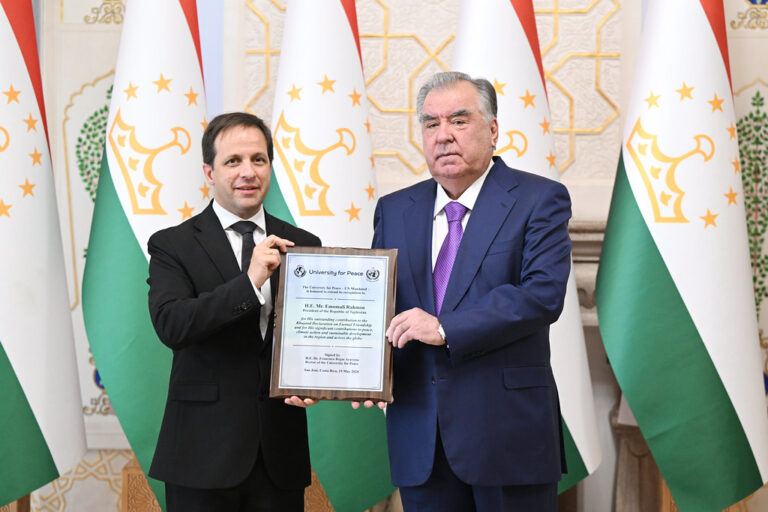
President Rahmon awarded UN University for Peace Certificate of Recognition

He is awarded for "significant contribution to establishing peace, developing regional cooperation, and strengthening mutual understanding between peoples."

Starlink satellite internet becomes available in Kyrgyzstan

And in Tajikistan, it was launched in February of this year.

In Dushanbe, 30 more new electric buses start operating

Each is designed to carry 100 passengers and can travel up to 300 kilometers without recharging.

Who is the man who “increased the Aryan race” and told the President of Tajikistan about it?

Kozie Koziyev, a folk craftsman, built dozens of houses, participated in the construction of a mosque and a kindergarten in Matcha, raised 11 children, and created a true dynasty of builders.

Tajik leader discusses water, climate, and global security issues with UN Deputy Secretaries-General

The parties paid special attention to the "Dushanbe Water Process," parliamentary diplomacy, and the peaceful resolution of conflicts.

Tajikistan completes the spring military draft target ahead of schedule

There is still a week left until the end of the conscription campaign.

Custodian of non-written languages and builder of academic bridges; philologist Khusrav Shambezoda turns 70

He could have devoted himself exclusively to the study of classical heritage, but he chose the challenging path of preserving the living word — and Tajik-Russian science gained in him a brilliant sociolinguist whose name became synonymous with dedication.

Tajikistan ranks among the top three leading trade reformers in Europe and Central Asia

The country has shown progress in the digitalization of trade procedures, the reduction of paper barriers, and the enhancement of transparency for exporters.

China to send workers to Tajikistan for modernization of the Kulma BCP

This is the only land border crossing point between Tajikistan and China.