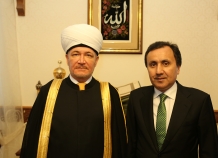
Russian grand mufti highly appraises Rahmon’s support for Hanafi madhab

DUSHANBE, February 11, 2016, Asia-Plus – Russian Grand Mufti Rawil Gaynetdin has met with Tajik Ambassador to Russia Imomuddin Sattorov. According to the official website of the Central Spiritual Administration of the Muslims of Russia (CSAMR), Rawil Gaynetdin has highly appraised Tajik President Emomali Rahmon’s support for the Hanafi madhab “that allowed to prevent spread of extremist […]

Asia-Plus

DUSHANBE, February 11, 2016, Asia-Plus – Russian Grand Mufti Rawil Gaynetdin has met with Tajik Ambassador to Russia Imomuddin Sattorov.

According to the official website of the Central Spiritual Administration of the Muslims of Russia (CSAMR), Rawil Gaynetdin has highly appraised Tajik President Emomali Rahmon’s support for the Hanafi madhab “that allowed to prevent spread of extremist ideas and avoid the splitting of the Muslim Ummah in Tajikistan.”

Russian grand mufti noted that CSAMR has published much literature on the Hanafi madhab “and its books are in demand in Central Asia.”

“Our activity also covers interests of Hanafi Muslims living in Europe and Asia,” Russian grand mufti told Tajik diplomat.  “During our visit to China, they proposed us to implement the project, The Hanafi Path, in addition to revival of the Silk Road.  We are waiting for proposal from our Chinese colleagues to hold a joint conference on problems of countering extremism and radicalism.”

On the problems facing Tajik labor migrants in Russia, Rawil Gaynetdin noted that many of them were not well aware of Islam, the foundations of their religion, and became objects of attention of extremists and terrorists.

“We also appeals to Tajikistan’s muftiyat with solicitation to send respected and competed imams to Russia so that they could help our imams educate Tajik nationals and put them on the right track,” Russian grand mufti said.

He also proposed to open an office of Tajikistan’s Islamic Center in Moscow for permanent interaction and joint work with parishioners arriving from Tajikistan.

Rawil Gaynetdin (born Ravil Ismagilovich Gaynutdinov) was born on August 25, 1959 in the village of Shali of Pestrechinsky District of the Tatar ASSR, Soviet Union to a Volga Tatar family. He has served as the Grand Mufti of Russia since July 1, 1996. He is one of the signatories of 

A Common Word between Us and You

, an open letter by Islamic scholars to Christian leaders, calling for peace and understanding.

Article translations:

Related Article

Оби зулол

Most Read

Join us on social media!

Aura

Recent Articles

Sanctions lifted: Dushanbe City Bank resumes international operations

The bank is returning to full-scale international operations.

Gasoline and diesel fuel in Dushanbe rose in price by 8.9% due to the war in the Middle East

The rise in global oil prices and, consequently, the cost of petroleum products has triggered the closure of the Strait of Hormuz.

The Ministry of Labor organizes consultations for migrants returning from Russia at Dushanbe airport

Employees of the Migration Service explain the requirements of Russian legislation and offer job vacancies in their homeland.

Tajikistan and Uzbekistan discuss simplification of customs procedures and implementation of VIN.TJ system

The VIN.TJ system is designed to simplify the process of vehicle registration and control.

Tajikistan climbs four places in the global fixed internet speed ranking

This is the country's best performance in the past five years.

President of Tajikistan launches hydro unit No. 7 at Nurek HPP

As of today, three units have been completely replaced at the country's largest hydroelectric power station.

Italian Opera in Dushanbe: Shohrukh Yunusov invites to an evening of musical revelations

The evening will feature the most recognizable Italian works alongside world and Tajik classics.

The European Union lifts sanctions on Tajik banks

This is attributed to successful reforms and improved financial transparency in the country.

Meta announced plans to lay off about 10% of its staff

The reason cited is the high costs of artificial intelligence development.