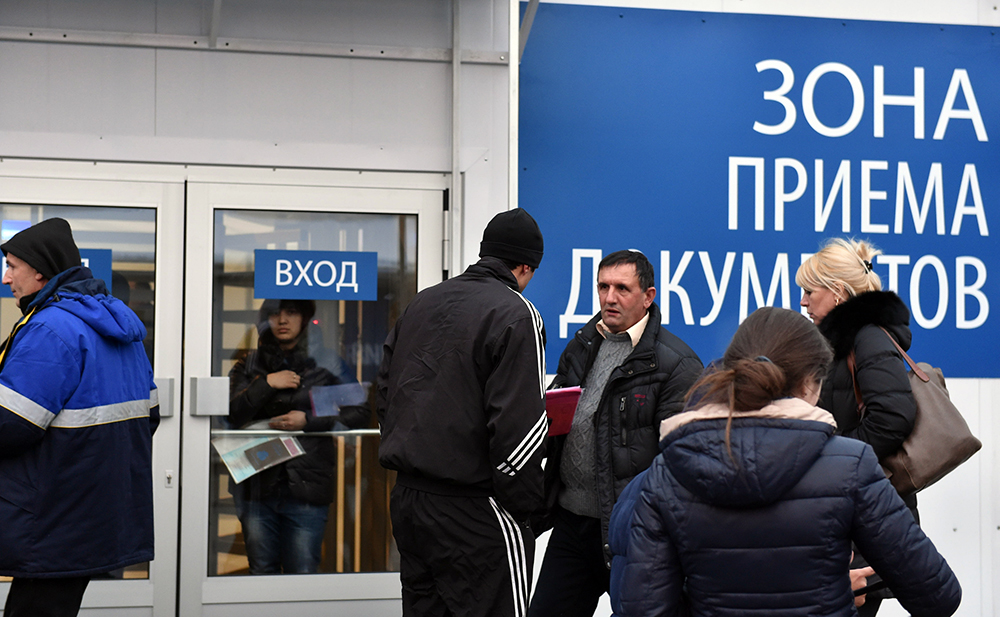
The cost of a patent to work in Russia depends on the corresponding region's demand for foreign workers.
The majority of regions in Russia have raised the patent prices. Thus, citizens of non-visa countries (‘visa-free foreign nationals’) working in Yakutia now pay for patent 8,762 Russian rubles and visa-free foreign nationals working in Yamal now pay for patent 8,219 Russian rubles.
Meanwhile, the patent prices have remained the same in six regions: Kaluga, Kemerovo, Moscow and Omsk oblasts as well as the cities of Moscow and St. Petersburg. The cost of the patent in these regions is 4,200 Russian rubles.
Russia’s national budget last year reportedly received more than 38 billion Russian rubles from selling labor patents.
Russian Interior Minister Vladimir Kolokoltsev noted in late December that Russia’s budget last year received more than 38 billion Russian rubles from selling labor patents, which was 1.5 times more than in 2015.
As a result of falling oil prices, which have drastically weakened the Russian ruble, work in Russia is now much less profitable. As a result, the number of foreign laborers has decreased—perhaps by 20-25 percent, according to Sergei Abashin, an anthropologist who studies labor migrants in Russia.
Meanwhile, adjustments to migration laws have had a similar effect, pushing migrants out of the country. Starting in 2015, the Russian government has only required labor migrants to purchase a special patent to work in Russia. On the surface, this new, simplified requirement has made it easier for post-Soviet labor migrants to legally work in the country. But the elevated cost of the patent has imposed “a very large burden on migrants, especially during an economic crisis,” Abashin says. Additionally, migrants must now pass an exam proving a basic knowledge of the Russian language and the country’s laws and history.
Recall, Russian president on November 24, 2014 signed a federal law that significantly changes the procedure for employing foreign nationals coming to the Russian Federation from non-visa countries.
The law aims to simplify the administrative procedure for employing visa-free foreign nationals by changing the quotas mechanism for the employment of visa-free foreign nationals under a patent by legal entities, individual entrepreneurs, notaries and lawyers engaged in private practice, and individuals who are Russian nationals.
The patent’s validity will range from one month up to one year; the deadline for reviewing an application is 10 business days. Visa-free foreign nationals are able to obtain a patent for a period from one month until the end of their respective employment or civil law agreement, but for no more than 12 months from the day of their entry to the Russian Federation. The patent preparation period (or a period for making a decision on patent denial) comes to 10 business days from the date when the migration authorities accept an application.
The patent validity period may be extended in case of personal income tax (PIT) prepayment. In this particular case, a foreign national will not have to turn to the migration authorities. Instead, in order to confirm the patent extension, he/she will need only the document itself and a statement certifying the next PIT prepayment.