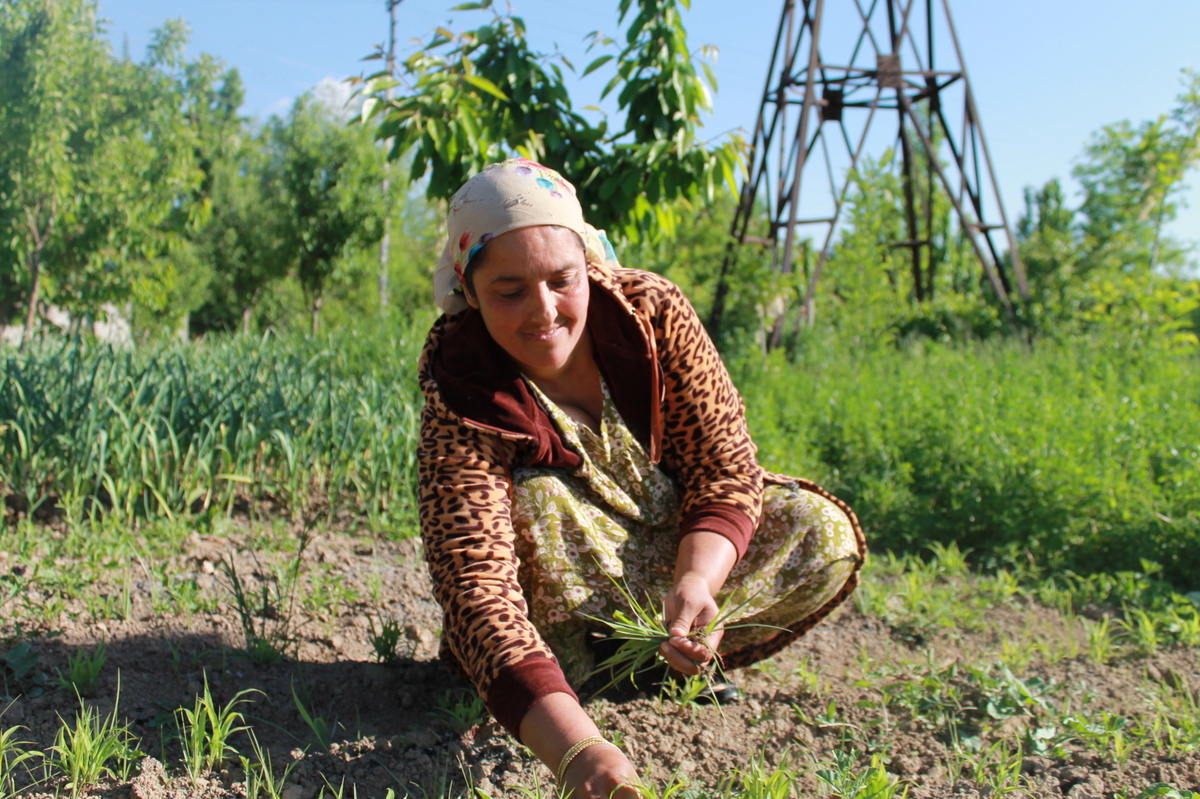
In the early morning of spring, in a distant field on the outskirts of Vahdat, the silhouette of a young woman emerges as she is working. She plants every seed carefully, with the hope that they will take root and grow. She works dexterously with her hands, hurrying to finish before the afternoon heat. Tired, but satisfied, Suvaydo, a 34-year-old refugee from Afghanistan returns home, where she had left her two children sleeping.
It has been eight years since Suvaydo and her children came to Tajikistan from troubled Afghanistan, settling in the outskirts of Vahdat, 30 km away from Dushanbe. Her story is tragic, but not one that is uncommon to women such as herself.
"I was a cheerful 16-year-old girl when the Taliban came and took me from my parents' house in Kunduz. They threatened us at gunpoint. I became the second wife of a man much older than me, who already had a wife, children and even grandchildren. There was no celebration, no wedding dress, nothing…" – Suvaydo recalls tearfully.
"I was constantly humiliated by my husband and his first wife. I was their servant doing all the chores from early morning to night. I was miserable, it was all so unbearable".
Although she felt trapped, as did many Afghan women in her place, she never lost hope of regaining her freedom.
Suvaydo's husband died four years later, leaving her with a daughter and a son. According to tradition, she was expected to marry one of her husband’s brothers. Suvaydo nevertheless refused to be forced into another marriage. Enraged by her behavior, her husband's relatives killed two of her brothers in vengeance. Knowing that the Taliban would continue to hunt them down, in 2009, Suvaydo, along with her children, parents and surviving brother fled from Afghanistan and found refuge in Tajikistan.
Tajikistan generously hosts 3000 asylum seekers and refugees, predominantly from Afghanistan. Having ratified the 1951 Refugee Convention and adopted a national Law on Refugees, the Government of Tajikistan has accorded protection, and access to healthcare, education and livelihoods for people who have fled violence, harm and conflict in their own countries.
Upon their arrival in Tajikistan, Suvaydo and her family received assistance from public organisation and UNHCR’s partner, Refugees, Children and Vulnerable Citizens (RCVC). Thanks to the tireless efforts of partners, civil society and the generosity of the Tajik host communities, asylum seekers and refugees, especially vulnerable families, are able to find their footing and slowly rebuild their lives.
Suvaydo and her children eventually managed to rent a small house, but it was very hard to make ends meet. She knew however that she could not expect to rely on help and needed to earn a sustainable living.
"I did whatever work I could find. I used to work as a dishwasher at weddings, now I'm a housekeeper in a family."
Last year, Suvaydo noticed that there were potentially arable fields in front of her house and came up with the idea of leasing four hundred square meters of land for cultivation, to supplement her income. She is not new to agriculture, having already learned how to work the ground in her native Afghanistan. RCVC on the other hand, provided Suvaydo a small grant, to help start her endeavour.
"My Tajik neighbors were surprised at how I was able to clear the stones and rubbish, and prepare the soil".
This year, Suvaydo is growing bamyon, known only in Afghanistan and targeted for the local refugee community market. She appreciates the little triumphs in life, and her positive outlook has helped her support her family, and leave her past behind. Suvaydo’s children, 16 year old Lido, and 12 year old Nurullo are attending school, even though their own mother was uneducated. Realising that she will never be able to return to Afghanistan, she is considering making a special plea before the Government of Tajikistan to be granted citizenship.
"I've already become a Tajik here, inherited the local traditions and lifestyle of Tajiks," – smiles Suvaido. "Although life is not easy, here I feel free, not imprisoned as when I was in Afghanistan”.
Suvaydo wants her children to have a better life, and not experience her difficulties and hardships. Suvaydo does not know what the future holds, but with the planting of every bamyon, she is sowing the seeds of hope for a brighter future.
UNHCR, the UN Refugee Agency works for a world where every person forced to flee can be protected and build a better future. On World Refugee Day marked every year on June 20th, the UNHCR Representation in Tajikistan remembers the strength, courage and perseverance of millions of refugees. The story of Suvaydo is the story of courage and patience in her daily struggle to live with dignity.