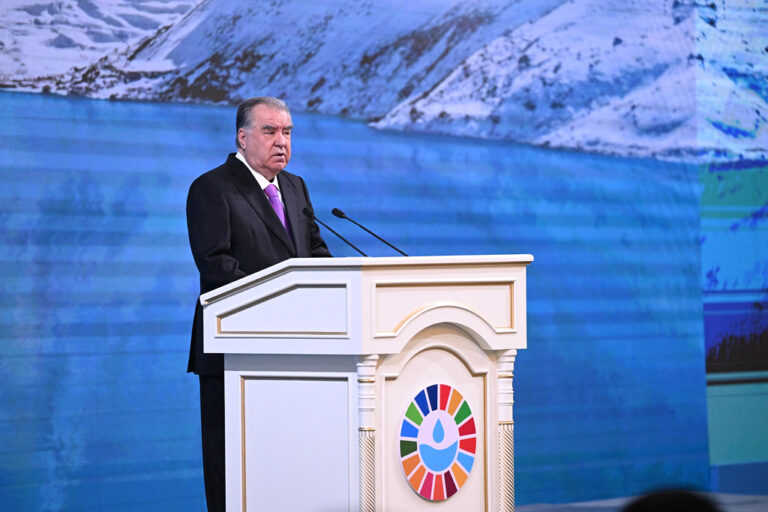
“The ‘BRICS Plus’ model China is actively exploring, which advocates dialogue between emerging markets and developing countries, should be strongly supported,” Tajik President Emomali Rahmon said in an interview with People’s Daily before the 9th BRICS Xiamen Summit and the Dialogue of Emerging Market and Developing Countries.
“I believe the summit and the dialogue are of special significance to promote solidarity and cooperation among the BRICS countries as they will be effective platforms to encourage mutually beneficial and constructive cooperation,” Rahmon was quoted as saying.
They will also facilitate the peaceful, safe and steady economic and social progress of participating countries amid new challenges brought by globalization, the president stressed his expectations toward the dialogue.
In Rahmon’s eyes, his attendance of the summit will bring benefit to Tajikistan’s national welfare and the people’s livelihood because the BRICS countries are at the stage of sustained economic development and have rich natural resources.
“The platforms like BRICS mechanism will bring about a broad range of development opportunities,” Rahmon said, illustrating that it will help cement China-Tajikistan mutually beneficial cooperation, expand trade and investment, guarantee stable development and bring benefit to the two peoples.
Additionally, the China-Tajikistan cooperation under the BRICS framework will propel the two countries to implement some cooperation plans and projects, he added.
President Rahmon has remained in China until September 5 to take part in events related to the September 3-5 summit of the BRICS group of emerging economies in the southeastern city of Xiamen.
BRICS is the acronym for an association of five major emerging national economies: Brazil, Russia, India, China and South Africa. Originally the first four were grouped as "BRIC" (or "the BRICs"), before the induction of South Africa in 2010. The BRICS members are all leading developing or newly industrialized countries, but they are distinguished by their large, sometimes fast-growing economies and significant influence on regional affairs; all five are G-20 members. Since 2009, the BRICS nations have met annually at formal summits. China is hosting the 9th BRICS summit in Xiamen on September 3rd, 4th and 5th, 2017.
All five members are in the top 25 of the world by population, and four are in the top 10. The five nations have a combined nominal GDP of US$16.6 trillion, equivalent to approximately 22% of the gross world product, combined GDP (PPP) of around US$37 trillion and an estimated US$4 trillion in combined foreign reserves. The World Bank expects BRICS growth to pick up to 5.3% in 2017. Bilateral relations among BRICS nations have mainly been conducted on the basis of non-interference, equality, and mutual benefit.