U.S. Government celebrates accomplishments of USAID Quality Reading Project

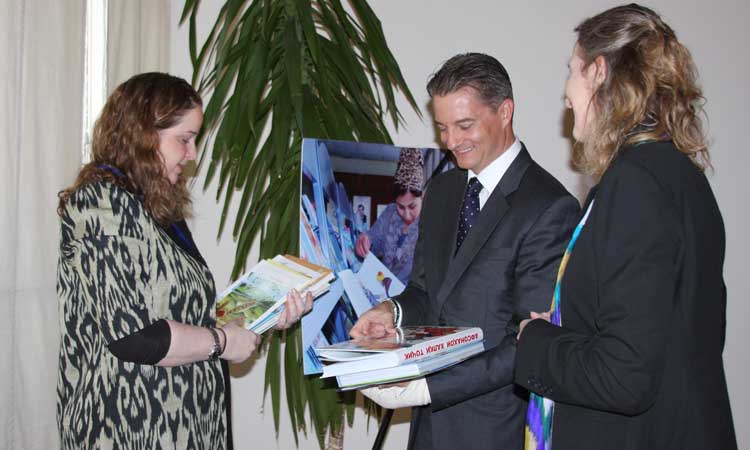
U.S. Chargѐ d’Affaires Kevin Covert has joined Deputy Minister of Education and Science Latofat Naziri, local education officials and stakeholders, implementing partners, students, librarians, and teachers to celebrate the shared accomplishments of the U.S. Agency for International Development (USAID) Quality Reading Project partnership as it closes after four years. According to the U.S. Embassy in […]

U.S. Chargѐ d’Affaires Kevin Covert has joined Deputy Minister of Education and Science Latofat Naziri, local education officials and stakeholders, implementing partners, students, librarians, and teachers to celebrate the shared accomplishments of the U.S. Agency for International Development (USAID) Quality Reading Project partnership as it closes after four years.

According to the U.S. Embassy in Dushanbe, through USAID, the U.S. Government partnered with the Ministry of Education and Science, the Republican Teacher Training Institute, the Republican Methodological Center, the Academy of Education, and the National Testing Center to improve reading instruction in Tajik and Russian language primary grade classes, reaching over 435,000 primary grade students.

The project trained 17,608 primary grade teachers in child-centered reading and literacy methods in 1,807 Tajik and Russian primary grade schools, donated 232,790 primary grade books to school libraries, and developed mentoring and coaching systems for primary grade schools.  The USAID Quality Reading Project also organized over 4,000 out-of-school activities, including reading camps, mobile puppet theater productions, and together with the Ministry of Education and Science, UNICEF, and Open Society International, subtitled an animated children’s educational television series, the first of its kind in the country.

The U.S. Chargѐ d’Affaires thanked the Ministry of Education, regional and district education departments and Tajikistan’s hardworking teachers, explaining that “having teachers who are engaging and access to mother tongue reading materials and out-of-school reading activities all encourage a culture of reading and help give children a strong foundation for lifelong learning.”

The USAID Quality Reading Project is one of the many assistance projects made possible by the American people through USAID.  Since 1992, the U.S government has provided over $1.8 billion in assistance that supports Tajikistan’s security, democratic institutions, social sector, and economic growth.

Join us on social media!

Article translations:

Related Article

Оби зулол
Оби зулол
Tenisi

Most Read

Коммерсбонк Точикистон

Recent Articles

RZD announces the restoration of passenger services between Moscow and Dushanbe

Direct rail services between the capitals of Russia and Tajikistan were suspended in March 2020 due to the COVID-19 pandemic.

#AP30/Stories. “Selam! Heller nichek?” How Tatars live today in Sughd province

On the 30th anniversary of "Asia-Plus," we continue to publish reports that remain relevant even after years. This story was told in 2021, and since then, little has changed in the life of the Tatar community in Tajikistan.

15,000 cameras, drones, and robots: how technology monitors pilgrims in Mecca and Medina

During Hajj 2026, Mecca and Medina were under unprecedented digital control.

Another child in Dushanbe removed from family and sent to boarding school

The Ministry of Internal Affairs reports that the parents did not pay adequate attention to the child.

Emomali Rahmon instructs to address issues in seed production following criticism of the industry

Issues have been noted with certification, seed quality, and the material and technical base of the industry.

Water, climate, and a $130 billion deficit: seven key outcomes of the Water Conference in Dushanbe

At the forum, countries and international organizations discussed new mechanisms for cooperation, investments, and technologies that are essential for addressing the global water crisis.

Eskhata Bank introduces a new generation children’s wallet

"Eshkata Bank" has created a full-fledged digital platform that helps children aged 7 to 16 learn how to manage money.