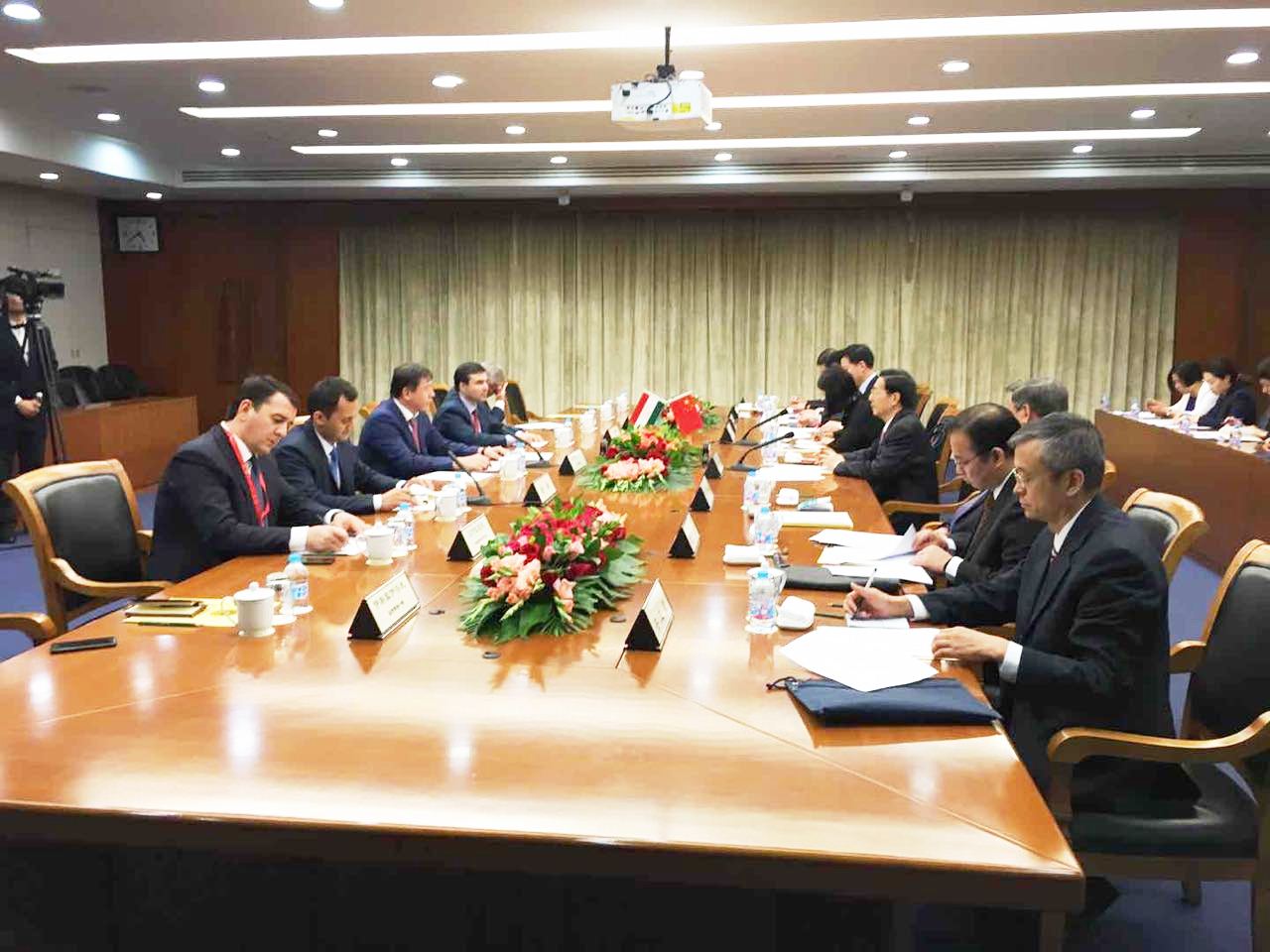
Tajik Interior Minister Ramazon Rahimzoda today met in Beijing with Chinese Minister of Public Security Guo Shengkun on the sidelines of the 86th session of Interpol General Assembly.
According to the Tajik Interior Ministry’s website, the two sides discussed state and prospects of further expansion of cooperation between their ministries in combating terrorism, extremism, separatism and drug trafficking.
Rahimzoda and Guo also exchanged views on the current political and criminogenic situation in Afghanistan, ways to prevent criminal acts along the Tajik-Afghan border and other modern threats and challenges.
Chinese minister reportedly noted that China is ready to assist Tajikistan with training of personnel for Tajikistan’s law enforcement authorities, especially in the field of combating cybercrimes and transnational organized crimes.
Guo also said that China is ready to assist Tajikistan with strengthening control of its common border with Afghanistan.
The Ministry of Public Security (MPS) is the principal police and security authority of China and the government agency that exercises oversight over and is ultimately responsible for day-to-day law enforcement. It currently has 1.9 million officers. It is headed by the Minister of Public Security. Prior to 1954, it was known as the Ministry of Public Security of the Central People's Government. The Ministry operates the system of Public Security Bureaus, which are broadly the equivalent of police forces or police stations in other countries. The candidate for the minister of the MPS is nominated by the Premier of the People's Republic of China and approved by the National People's Congress.
As the main domestic security agency in the People's Republic of China, the MPS is the equivalent of the National Police Agency in Japan or national police in other countries. Since the creation of the Ministry of State Security in 1983, the MPS does not undertake riot control functions, which are now under the control of People's Armed Police, nor does it generally conduct domestic intelligence which since 1983 has been a primary responsibility of the Ministry of State Security. Hong Kong and Macau have their own security bureaus/agencies and police forces.