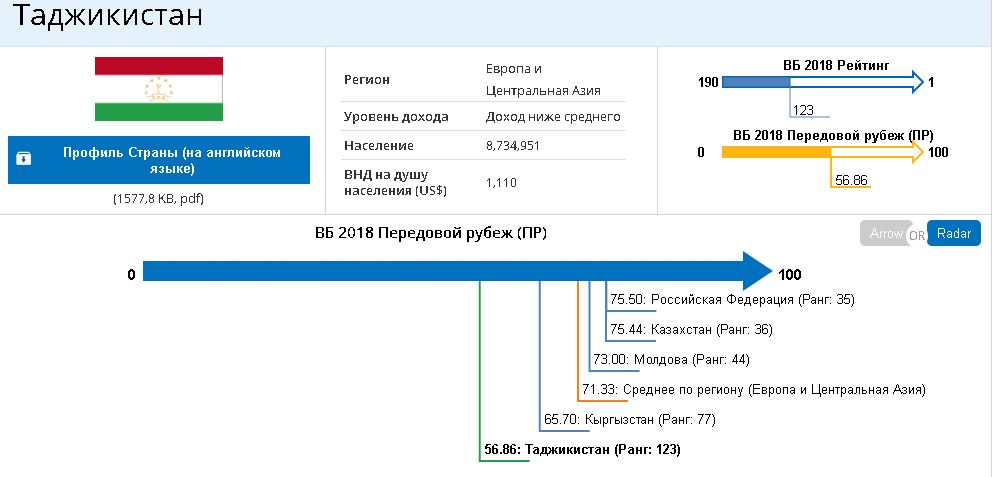
Tajikistan has improved its position in the Doing Business Index climbing five spots to the 123rd place among 190 economies in the 15th anniversary edition of the World Bank Group’s annual Doing Business 2018: Reforming to Create Jobs Report, released on October 31, 2017.
According to the report, Tajikistan implemented reforms in two areas: starting a business and registering property.
The country has reportedly raised the revenue threshold for mandatory value added tax registration, making it easier to register a new business. Tajikistan also made it easier and less costly to register property by eliminating the need to register the sale-purchase agreement at the municipal office.
The report says Tajikistan improved its positions in five of the ten Doing Business indicator sets. The country reportedly climbed 28 spots in the Starting Business indicator set, 28 spots in the Dealing with Construction Permits indicator set, 8 spots in the Paying Taxes indicator set, 7 spots in the Registering Property indicator set, and 2 spots in the Getting Electricity indicator set.
As far as the Enforcing Contracts indicator set is concerned, Tajikistan has remained in the same place — 54th.
In the remaining four indicator sets, Tajikistan’s position in these indicator sets has deteriorated. The country reportedly fell 6 spots in the Protecting Minority Investors indicator set, 5 spots in the Trading across Borders indicator set, 4 spots in the Getting Credits indicator set, and 4 spots in the Resolving Insolvency indicator set.
As far as other Central Asia’s nations are concerned, Kazakhstan is ranked 36th, Uzbekistan 74th, and Kyrgyzstan 77th.
The report says that while the Central Asian countries have actively tackled the areas covered by Doing Business in recent years, there is still a room for improvement in the areas of Getting Electricity, Paying taxes and Trading across Borders. For example, it takes an entrepreneur 106 days, and 639 percent of income per capita to get connected to the electric grid in Central Asia, compared to 79 days and 63 percent of income per capita in OECD high-income economies. Similarly, paying taxes in Central Asia takes 202 hours on average compared to the OECD high-income average of 161 hours. Finally, the time and cost to export and import from and to the region are also higher compared to the OECD and global averages.
The Doing Business project, launched in 2002, measures regulations affecting domestic firms in 190 countries. By gathering and analyzing comprehensive quantitative data to compare business regulation environments across economies and over time, Doing Business encourages economies to compete towards more efficient regulation; offers measurable benchmarks for reform; and serves as a resource for academics, journalists, private sector researchers and others interested in the business climate of each economy. Doing Business 2018: Reforming to Create Jobs is the 15th in a series of annual reports.