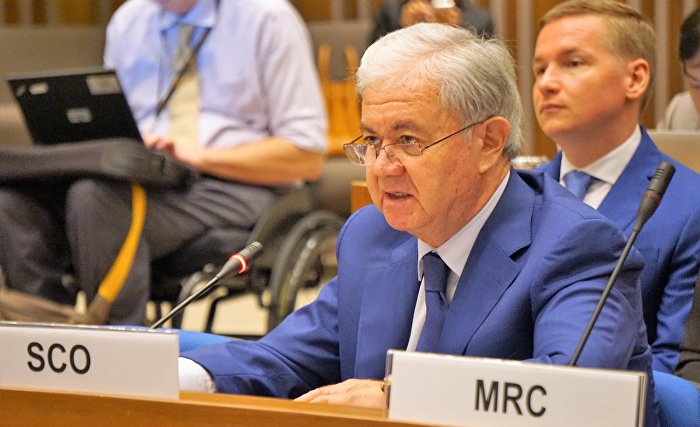
On November 23, the high-level segment of the Second Ministerial Conference on Regional Economic Cooperation and Integration in the Asia-Pacific Region began its work at the headquarters of the United Nations Office in Bangkok. At the joint invitation of ESCAP and the Asian Development Bank (ADB), the delegation of the SCO Secretariat led by Secretary-General Rashid Alimov.
On the first day, speaking before the participants of the conference, Rashid Alimov presented detailed information on the cooperation of the SCO member states in the economic field, indicating this as one of the priorities of joint work within the Organization, according to the website of the organization.
He recalled the "continuing turbulence of the world economy, representing one of the most serious challenges to the modern world."
"To give impetus to its restoration, to ensure economic and financial stability, to support a stable dynamic, balanced and inclusive growth in the context of the progress of economic globalization is possible only through broad international cooperation", — Alimov noted.
the Secretary General stressed that the economic interconnectedness of the SCO member states is determined by their geographical proximity, as well as by agreements and joint development programs.
"Today, the SCO participants concentrate on projects related to the development of infrastructure, transport, communications, and are searching for new forms and methods of regional economic interaction. This contributes to the steady growth of mutual accumulated investments of the SCO member states, which in 2016 exceeded $ 40 billion", — Said Alimov.
Rashid Alimov also noted that economic cooperation within the framework of the SCO is provided by a system of multilateral mechanisms of relevant ministries and departments in the field of customs and transport, trade and investment, banking and finance, agriculture, communications and telecommunications.
Separately, Alimov touched on the topic of transport cooperation within the Organization and recalled the special significance of the implementation of the Agreement of the SCO member states on the creation of favorable conditions for international road transport, which laid the foundation for the implementation of a large multilateral trans-regional transport project.
"The document created a uniform basis for the implementation of international road transport, and its main routes form a region-wide system of automobile goods and passenger transportations. The principal point is that the states that are not members of the SCO can freely join the agreement, some of which are of great practical interest", — the Secretary-General noted.
The second UN ministerial conference on regional economic cooperation and integration in the Asia-Pacific region is taking place at the headquarters of ESCAP in Bangkok from 21 to 24 November. Its participants are considering economic cooperation in the vast region of ESCAP, with an emphasis on supporting the implementation of the Agenda for Sustainable Development until 2030. The conference also discusses issues related to removing obstacles to the path of broader market integration, strengthening regional financial cooperation.