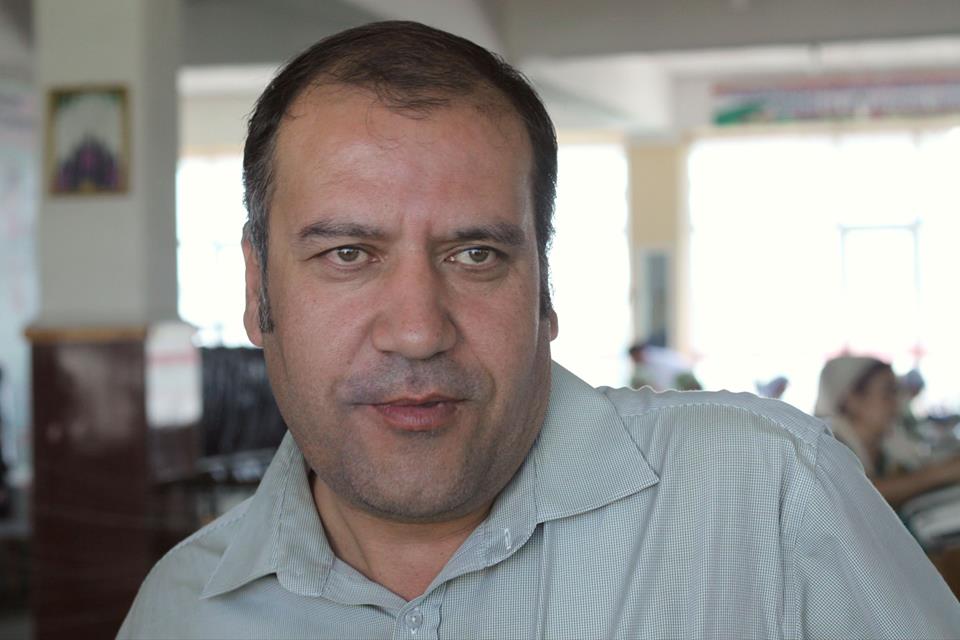
“I have seen my detained son only once over the past month,” Habibullo Mirsaidov, father of Khairullo Mirsaidov, told Asia-Plus in an interview on January 5.
According to him, an investigation is under way and Khairullo Mirsaidov does not admit to the charges brought against him.
Recall, Khairullo Mirsaidov, who is the head of the Khujand based KVN team, was put under custody on December 5 and charges of misappropriate of state funds (Article 245, Part 4 of Tajikistan’s Penal Code), inciting national racial, regional or religious enmity (Article 189, Part 2), document forgery (Article 340, Part 1) and false denunciation (Article 346, Part 2) were officially brought against him on December 8.
The charges brought against Mirsaidov carry up to a total of 21 years in prison under Tajikistan’s Penal Code.
Khairullo Mirsaidov in November last year applied to the President of Tajikistan, Prosecutor-General Yusuf Rahmon and Sughd Governor Abdurahmon Qodiri, asking them to pay attention to problems facing the Khujand-based KVN team because of some corrupt officials in the Sughd province. Mirsaidov publicly stated that Olim Zohidzoda, the head of the Sughd directorate for youth and sports affairs, demanded a US$1,000 bribe.
Mirsaidov failed to produce evidence to support his application against Zohidzoda. Zohidzoda has filed a counterclaim against Mirsaidov accusing him of defamation.
A number of human rights organizations last month released statements urging the Tajik authorities to ensure Khairullo Mirsaidov’s rights in detention, including to be free from ill treatment.
KVN (a Russian abbreviation for the Club of the Funny and Inventive People) is a Russian-speaking humor TV show and competition where teams compete by giving funny answers to questions and showing prepared sketches, that originated in the Soviet Union. The program was first aired by the First Soviet Channel on November 8, 1961. Eleven years later, in 1972, when few programs were being broadcast live, Soviet censors found the students' impromptu jokes offensive and anti-Soviet and banned KVN. The show was revived fourteen years later during the Perestroika era in 1986, with Alexander Maslyakov as its host. It is one of the longest-running TV programs on Russian Television.
During the Perestroika era, KVN spread to Russian expatriate communities around the world. In 1992 the Israel team tested the waters playing against the CIS team. The game was an unquestionable success and more international games on a highest level followed: the CIS team visited Israel, Germany and USA. The culmination was in 1994 with the First KVN World Festival in Israel with 4 teams (USA, Israel, CIS and Germany).