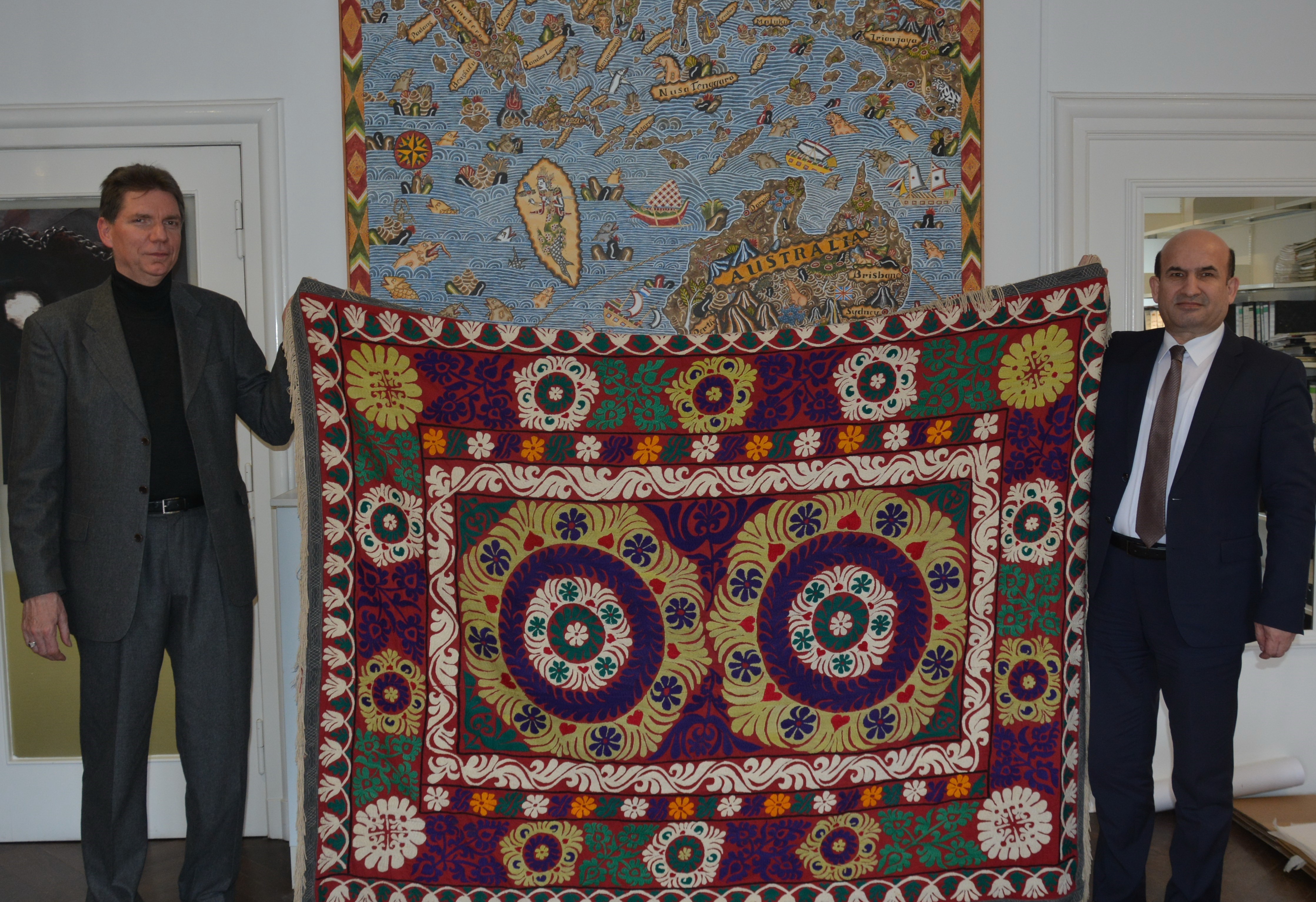
On Monday March 5, Tajik Ambassador to Germany Maliksho Nematov visited the Ethnological Museum of Berlin and held talks with Dr. Lars-Christian Koch, Director of the Ethnological Museum of Berlin, according to the Tajik MFA information department.
The two reportedly exchanged views on the issues related to collaboration between the Ethnological Museum of Berlin and the Tajikistan National Museum.
In the course of the talks, Nematov reportedly informed Dr. Koch that the Year 2018 had been declared the Year of Development of Tourism and Folk Crafts in Tajikistan.
For his part, Dr. Koch expressed readiness to organize exhibition of works by Tajik painters and craftsmen in a new building of the ethnological Museum.
At the end of the meeting, Ambassador Nematov reportedly donated a sample of Chakan embroidery to the Ethnological Museum.
Tajikistan National Museum is housed in an impressive modern building with an elliptical roof and giant atrium. The collection encompasses three main sections – natural history, archaeology and contemporary fine arts – and displays include minerals (including a giant mineral tree), dioramas of snow leopards and Marco Polo sheep, suits of armor and musical instruments. Among the most important exhibits are the murals from ancient Panjakent and an exquisite 10th-century wooden mehrab (mosque prayer niche) found near Ayni.
Other noteworthy parts of the museum's modest collection is a reconstruction of the 7th-century Ajina-Tepe Buddhist monastery (the original reclining Buddha is housed in the National Museum of Antiquities) and an interesting set of gifts to the state, mostly modern, from around the world.
Founded in 1873, the Ethnological Museum of Berlin is one of the Berlin State Museums, the de facto national collection of the Federal Republic of Germany. It is presently located in the museum complex in Dahlem, along with the Museum of Asian Art and the Museum of European Cultures. The museum holds more than 500,000 objects and is one of the largest and most important collections of works of art and culture from outside Europe in the world. Its highlights include important objects from the Sepik River, Hawaii, the Kingdom of Benin, Cameroon, Congo, Tanzania, China, the Pacific Coast of North America, Mesoamerica, the Andes, as well as one of the first ethnomusicology collections of sound recordings.
As the museum’s collections expanded in the early twentieth century, the museum quickly outgrew its facility in the center of Berlin. A new building was erected in Dahlem to house the museum’s store rooms and study collections.