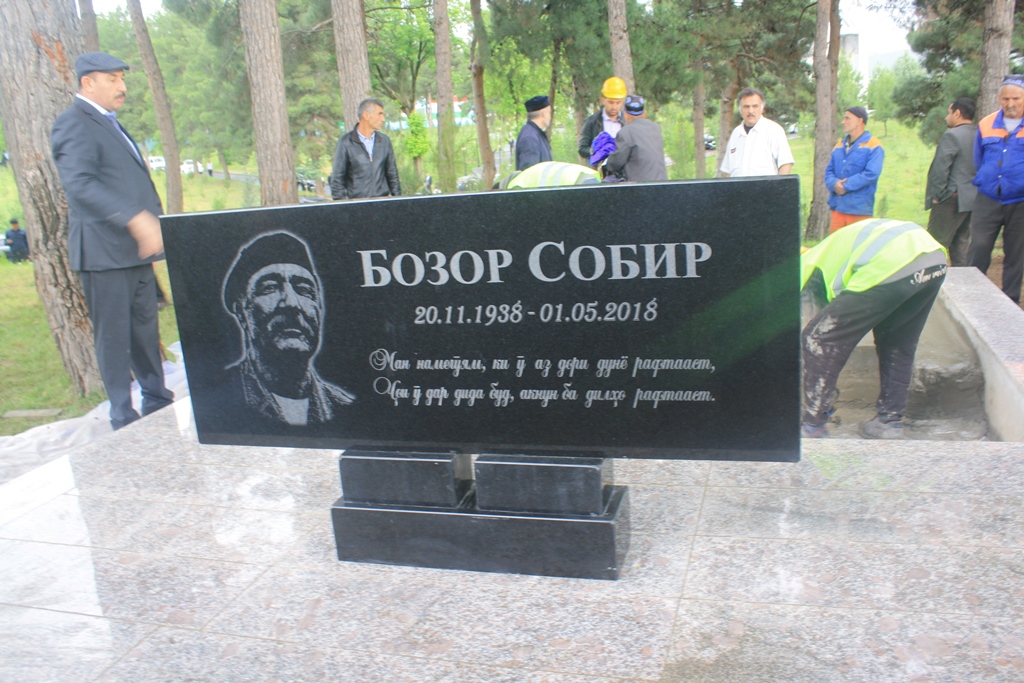
His verses will live eternally. Bozor Sobir buried at Luchob cemetery in Dushanbe

The body of Tajik prominent poet Bozor Sobir has been repatriated from the United States to Tajikistan and he was buried next to another prominent Tajik poet Loiq Sherali at Luchob cemetery in Dushanbe on May 14.   Bozor Sobir’s widow, Gulchehra Sobir, and his daughter Shogouna Sobir arrived in Dushanbe to say final farewell to […]

Asia-Plus

The body of Tajik prominent poet Bozor Sobir has been repatriated from the United States to Tajikistan and he was buried next to another prominent Tajik poet Loiq Sherali at Luchob cemetery in Dushanbe on May 14.  

Bozor Sobir’s widow, Gulchehra Sobir, and his daughter Shogouna Sobir arrived in Dushanbe to say final farewell to the poet.     

Bozor Sobir died at a hospital in Seattle, the United States on May 1, aged 79 after a long illness.  He had been hospitalized in early April with lung problems, she said.

Tajik President Emomali Rahmon ordered diplomats to arrange the repatriation of Sobir's body for burial in Dushanbe.

Born in the village of Sufiyon in Fayzobod district on November 20, 1938, Bozor Sobir received his early education in the Fayzobod district before graduating from the Faculty of Tajik Philology at Tajik National University in 1962.

He had worked for the magazines Maorif va Madaniyat (Education and Culture) and Sadoyi Sharq (Voice of the East).

Bozor Sobir gained prominence and popularity in the 1970s and '80s for his poetry in Tajikistan, then a Soviet republic.

Bozor Sobir's poems were translated into English, German, Spanish, and Russian, as well as several other languages of the former Soviet republics.  Books of his poetry were also issued in Afghanistan and Iran.

With the advent of glasnost he became actively involved in the political and cultural movements for an independent national identity.  Four major collections of his verse were published in the 2000s.

Bozor Sobir was once a leading member of the Democratic Party of Tajikistan.   He resigned from the party in November 1992 reportedly because of disagreement with the party leadership.

On March 26, 1993, Bozor Sobir was arrested at the Dushanbe airport, where he had gone reportedly to send a parcel to his son who was living that time in Moscow.

On April 5, 1993, Bozor Sobir was charged with public calls to overthrow the government, hostage-taking, and inciting social discord.   Sobir denied the charges, calling them politically motivated.  He spent nine months in pretrial detention facility but was released with the help of international human rights organizations and in December 1994, he left Tajikistan for the United States, where he resided for 19 years before he returned to Tajikistan in May 2013.
Join us on social media!

Article translations:

Related Article

Оби зулол
Оби зулол

Most Read

Recent Articles

The only GPW veteran in Dushanbe allocated more than 80,000 somoni

The mayor's office of Dushanbe allocated him 25,000 somoni.

GITEX AI Kazakhstan 2026: how Almaty became the main AI hub of Central Asia

More than 300 companies and startups, over 200 speakers and 100 investors from 50 countries — the region is entering the global stage.

A trade and economic park to be built at the border junction of Tajikistan, Kyrgyzstan, and Uzbekistan

President of the Kyrgyz Republic Sadyr Japarov familiarized himself with the project.

A project to protect soil from degradation to be developed in Central Asia

The initiative is of great significance for the mountainous countries of the region, including Tajikistan.

Mudslide, death, and destroyed homes: hundreds of families in Tajikistan left homeless

A correspondent from "Asia-Plus" visited Kulob and spoke with the families of those who died and were affected by the disaster.

Spring 2026 bright event: new issue of VIPzone now on sale

This issue is about people and ideas that change everything: from business and investments to fashion, food, and urban environment.

Godfrey Sullivan: “Tajikistan is a promising market for Visa to develop digital payments”

The Vice President of Visa explained why Tajikistan is becoming a promising market for digital payments and how artificial intelligence is influencing the future of finance.

Seven students in Dushanbe were threatened with expulsion for arriving at universities in personal cars

The materials for each case have been sent to the Ministry of Education and Science for appropriate actions.

India’s blockchain push and lessons for the global south

The Indian Government has started pushing aggressively its agenda...

India’s blockchain push and lessons for the global south

The Indian Government has started pushing aggressively its agenda...