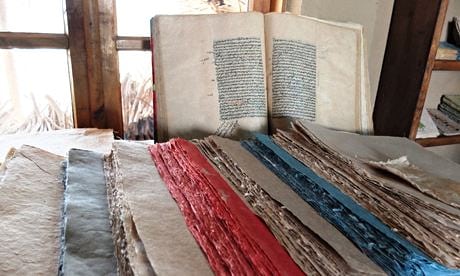
Centuries-old secret of Samarqand paper

The first report of a new project, Salom Sosedi (Salam Neighbors), is about Samarqand silk paper, the centuries-old method of production of which has been revived by a craftsman Zarif Mukhtorov from the Uzbek village of Konigil, some 5 kilometers from the city of Samarkand.  According to him, he had tried for years to discover […]

Asia-Plus

The first report of a new project, Salom Sosedi (Salam Neighbors), is about Samarqand silk paper, the centuries-old method of production of which has been revived by a craftsman Zarif Mukhtorov from the Uzbek village of Konigil, some 5 kilometers from the city of Samarkand.  According to him, he had tried for years to discover the lost art of Samarkand paper-making.

Samarqand paper was renowned for its quality. Many Persian and Arabic manuscripts of the ninth and 10th centuries were written on it. 

It was betrayal that brought the paper-making craft to Samarqand.  In the year 751 the Chinese invaded Central Asia, but the ruler of Samarqand defeated their troops and captured many thousands of soldiers.  To save their lives, the story goes, craftsmen among the captives revealed their knowledge of paper-making to their captors.  From then on, Samarqand became a center for paper production.  But following Russian colonization of the Silk Road city in the 19th century and the start of industrial production, the ancient recipe got lost.

Today, visitors to one of the only workshops for handmade paper in Central Asia can learn the secrets of a 1,000-year-old production process.

Zarif Mukhtarov, a professional ceramist, in 1995 took part in a UN conference dedicated to lost culture in Uzbekistan.  Samarqand paper was one of the topics.  

In 2001 Mukhtorov started to build his own paper workshop.  Some funding was provided by US and Japanese foundations, but most of the money was invested by Mukhtarov himself. The Guardian reported on June 2, 2014.

Today the paper workshop is a must-see site for tourists coming to Uzbekistan.  Each year some 5,000 visitors reportedly seek out his picturesque mud-brick workshop with a chattering wooden watermill by the Siyob river. The location was no coincidence; once, there were 400 watermills around Samarkand, many of them in Konigil.

Visitors find a variety of products: silk-like or hairy paper in cream, blue, yellow or pink; notepads and wallets; even puppets and masks.  All of them are made of paper. 

Join us on social media!

Article translations:

Related Article

Оби зулол
Оби зулол

Most Read

Recent Articles

The only GPW veteran in Dushanbe allocated more than 80,000 somoni

The mayor's office of Dushanbe allocated him 25,000 somoni.

GITEX AI Kazakhstan 2026: how Almaty became the main AI hub of Central Asia

More than 300 companies and startups, over 200 speakers and 100 investors from 50 countries — the region is entering the global stage.

A trade and economic park to be built at the border junction of Tajikistan, Kyrgyzstan, and Uzbekistan

President of the Kyrgyz Republic Sadyr Japarov familiarized himself with the project.

A project to protect soil from degradation to be developed in Central Asia

The initiative is of great significance for the mountainous countries of the region, including Tajikistan.

Mudslide, death, and destroyed homes: hundreds of families in Tajikistan left homeless

A correspondent from "Asia-Plus" visited Kulob and spoke with the families of those who died and were affected by the disaster.

Spring 2026 bright event: new issue of VIPzone now on sale

This issue is about people and ideas that change everything: from business and investments to fashion, food, and urban environment.

Godfrey Sullivan: “Tajikistan is a promising market for Visa to develop digital payments”

The Vice President of Visa explained why Tajikistan is becoming a promising market for digital payments and how artificial intelligence is influencing the future of finance.

Seven students in Dushanbe were threatened with expulsion for arriving at universities in personal cars

The materials for each case have been sent to the Ministry of Education and Science for appropriate actions.

India’s blockchain push and lessons for the global south

The Indian Government has started pushing aggressively its agenda...

India’s blockchain push and lessons for the global south

The Indian Government has started pushing aggressively its agenda...