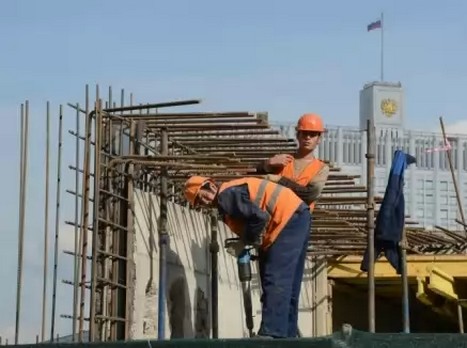
The number of migrant workers is increasing in the Russian oblast (region) of Astrakhan and their contribution to the oblast’s budget is also increasing due to purchase of patents and tax payments, news website Punkt A reports.
Since the beginning of the year, 36,300 foreign nationals have been registered with the Interior Ministry’s Directorate for Astrakhan Oblast and 13,800 of them have arrived in Astrakhan for seasonal work.
The majority of the labor migrants have reportedly got patent/work permit. Over the first four months of this year, guest workers have contributed 106.1 million Russian rubles (RR) in income taxes to the oblast’s budget (over the same period last year, labor migrants contributed RR80.55 million in income taxes to Astrakhan’s budget), according to Punkt A.
Increase in inflow of migrants has not told on increase in the number of crimes reported in the region. “The share of migrants in the number of crimes committed over the repot period was only 2.4 percent,” Aleksey Veselovsky, an acting chief of the Migration Department the Interior Ministry’s Directorate for Astrakhan Oblast, told Punkt A in an interview.
Meanwhile, migrant labor last year reportedly contributed more to the Moscow city budget in taxes than all the oil and gas giants headquartered in Russia’s capital. Despite being a major budgetary resource for the state, migrants living and working in Russia continue to be portrayed as a potential threat that requires strict controls, according to Refugees Deeply, an independent digital media project.
Russia’s current migration management framework is reportedly designed to keep labor migrants on a short leash while at the same time extracting maximum revenue from the barriers it places.
The fact that most labor migrants can enter the country without difficulty as a result of a visa-free policy with CIS countries might make it appear welcoming. But once migrants are inside Russia, they encounter a legal framework designed to push them into a vulnerable state of semi-legality. They often find themselves on the wrong side of contradictory regulations they were unaware of, Refugees Deeply says.
Russia applies a so-called “patent” system for regulating labor migration for citizens arriving from CIS countries that enjoy visa-free travel to Russia and are not members of the Eurasian Economic Union. Initially designed to allow migrants to work for private individuals as manual laborers or domestic workers, the patent model has been expanded to include all forms of labor migration. After indicating “work” as the purpose of their visit, labor migrants under the patent system have between seven and 15 days to register their place of residence – a difficult feat for recent arrivals, given the fact that the physical presence of the landlord is required at registration. Given the extreme time constraints, many migrants pay intermediaries or their future employers to register them at an address where they will not actually reside.
Migrants then have 30 days after arrival to apply for the coveted work patent in order to have permission to work legally in Russia. Patents are issued for one year and require migrants to submit monthly tax payments to ensure the validity of the permit (missing or late payments result in the permit being annulled). Obtaining the patent involves passing a full medical exam that includes testing for HIV, leprosy, tuberculosis, drug use and STDs.