



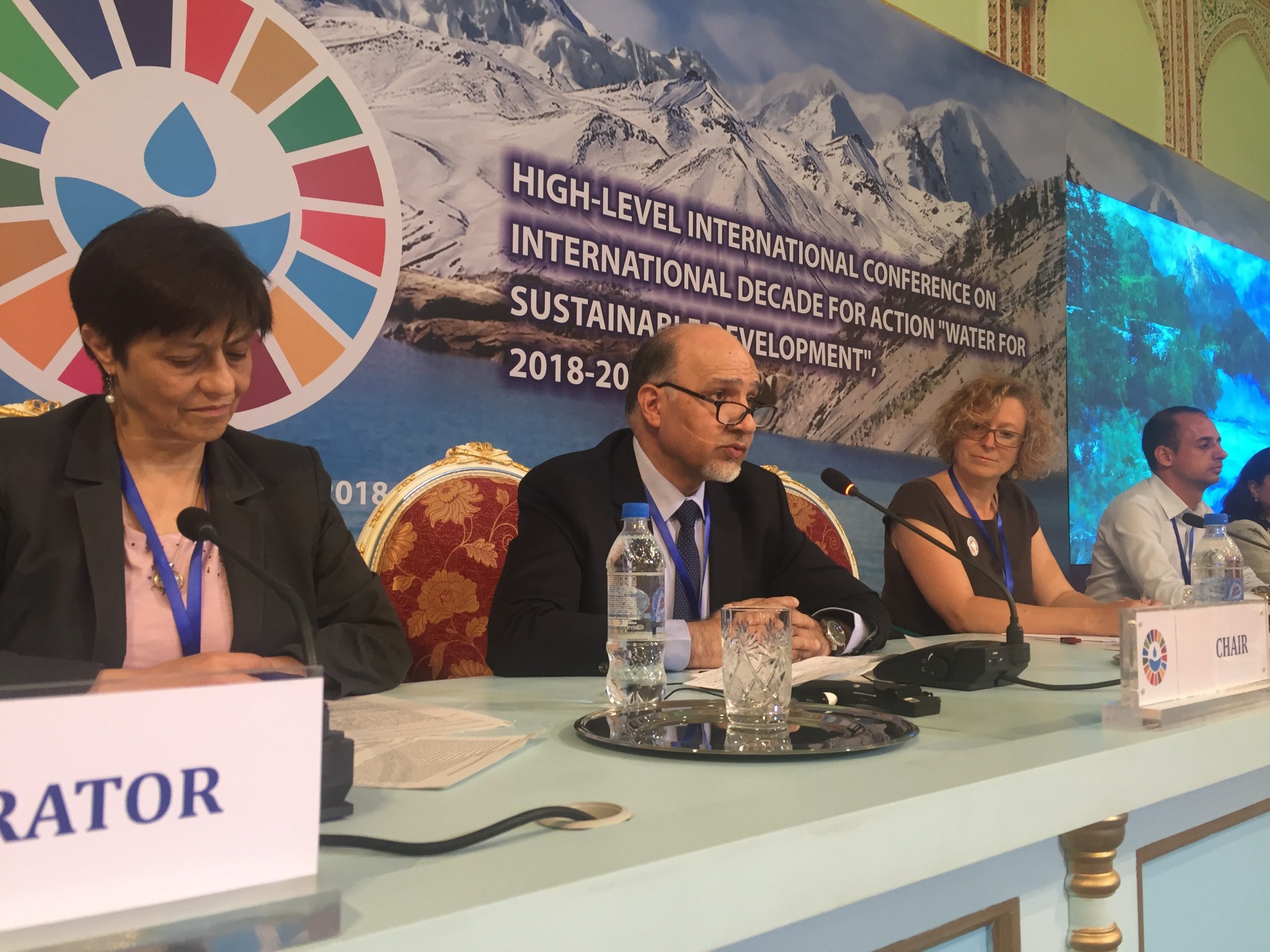
UNDP, UNESCO hold action panel on capacity building within the high-level international conference on water in Dushanbe

UNDP Istanbul Regional Hub Manager Gerd Trogemann yesterday emphasized the importance of water related education in consolidating global efforts to adapt to climate change and to eradicate poverty, as he spoke at the action panel on capacity building organized by UNDP and UNESCO within the High-Level International Conference on International Decade for Action “Water for […]

UNDP Istanbul Regional Hub Manager Gerd Trogemann yesterday emphasized the importance of water related education in consolidating global efforts to adapt to climate change and to eradicate poverty, as he spoke at the action panel on capacity building organized by UNDP and UNESCO within the High-Level International Conference on International Decade for Action “Water for Sustainable Development” 2018-2028.

According to UNDP Tajikistan, Gilbert Houngbo, President of International Fund for Agricultural Development (IFAD), and Mahmoud Saikal, Permanent Representative of Afghanistan in the United Nations in New York, co-chaired the panel.

“Clean, accessible water is critical for sustainable development and the eradication of poverty and hunger, and it is indispensable for human development, health and well-being… In the integrated 2030 Agenda, it is important that we do not look at capacity development as merely a technical process, as a transfer of knowledge or institutions. Capacity development to achieve the SDGs is about country ownership and leadership, it is about adaptive, integrated, whole of society approaches that consider the broader socio-political context,” Trogemann said.

The panelists strongly advocate for creation and development of programs targeting decision makers and water professionals to raise awareness about the importance of investing in capacity building and strong international cooperation on the highest political level. 

Theу highlighted some existing programs, including the UNDP Water and Ocean Governance Programme, specifically Cap-Net, and UNESCO International Hydrological Programme (UNESCO-IHP), already working in this direction on all levels.

UNDP has a number of projects in Tajikistan, working to help the population make a more efficient and sustainable use of the country’s water resources, to better deal with water-related natural calamities and to increase adaptation capacity to climate change.


Join us on social media!

Article translations:

Related Article

Оби зулол
Оби зулол
Tenisi

Most Read

Коммерсбонк Точикистон

Recent Articles

RZD announces the restoration of passenger services between Moscow and Dushanbe

Direct rail services between the capitals of Russia and Tajikistan were suspended in March 2020 due to the COVID-19 pandemic.

#AP30/Stories. “Selam! Heller nichek?” How Tatars live today in Sughd province

On the 30th anniversary of "Asia-Plus," we continue to publish reports that remain relevant even after years. This story was told in 2021, and since then, little has changed in the life of the Tatar community in Tajikistan.

15,000 cameras, drones, and robots: how technology monitors pilgrims in Mecca and Medina

During Hajj 2026, Mecca and Medina were under unprecedented digital control.

Another child in Dushanbe removed from family and sent to boarding school

The Ministry of Internal Affairs reports that the parents did not pay adequate attention to the child.

Emomali Rahmon instructs to address issues in seed production following criticism of the industry

Issues have been noted with certification, seed quality, and the material and technical base of the industry.

Water, climate, and a $130 billion deficit: seven key outcomes of the Water Conference in Dushanbe

At the forum, countries and international organizations discussed new mechanisms for cooperation, investments, and technologies that are essential for addressing the global water crisis.

Eskhata Bank introduces a new generation children’s wallet

"Eshkata Bank" has created a full-fledged digital platform that helps children aged 7 to 16 learn how to manage money.





