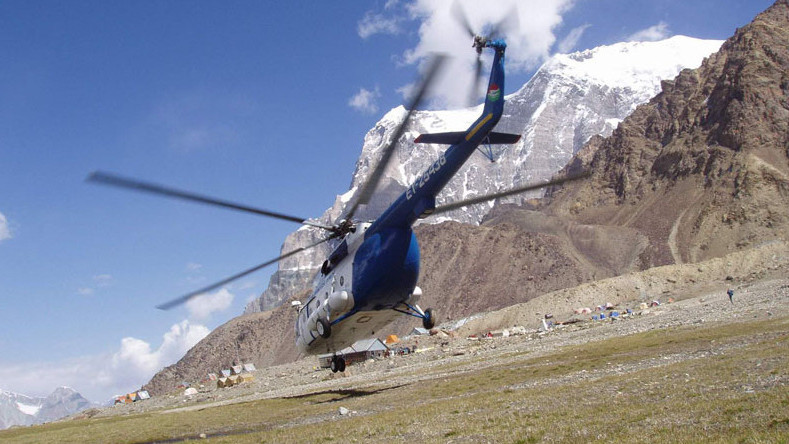
The Committee on Emergency Situations and Civil Defense (CES) under the Government of Tajikistan has published names of those killed in a Sunday helicopter mountain crash. Survived mountaineers have been hospitalized; three of them have already left hospital (all of them are citizens of Russia), while two others – one of them is citizen of Russia and the other one is citizen of Spain – are in serious condition.
Among those killed in the crash are commander of the helicopter Muzaffar Fayzulloyev, 71, pilot Saidjon Qobilov, 61, and three mountaineers, including Alexander Abrosimov, 47, Ruslan Tarakanov, 42, and Timur Barabanov, 32 (all of them are citizens of the Russian Federation).
According to the preliminary data, the crash was caused by bad weather conditions – strong wind and bad visibility.
According to CES, the helicopter was carrying fifteen mountaineers, namely Alexander Abrosimov, 47, Ruslan Tarakanov, 42, Timur Barabanov, 32, Viktor Dubin, 66, Sergei Mironov, 54, Andrei Rodyqin, 38, Sergei Matveyev, 41, Alexader Sobolenko, 48, Dmitry Kumshayev, 44, Tatiana Gorbatyuk, 49, Vyacheslav Trush, 44, Pavel Shubin, 53, and Yulia Feigina, 42 (all of them are nationals of the Russian Federation) as well as Nikolai Shikhov (citizen of Belarus), 60, and Roberto Rodrigo (citizen of Spain), 49.
All the survived mountaineers and the helicopter air mechanic Bobonazar Jalilov, 33, have been hospitalized in Dushanbe’s Medical Center “Istiqlol.”
Recall, CES has initially reported that an Mi-8 helicopter with 3 crew and 15 mountaineers on board was forced to make a crash landing Sunday (August 12) afternoon, at about 4:30 pm, as it approached the base camp at the Fortambek Glacier.
The mountaineers were reportedly returning to the base camp after ascending Tajikistan’s tallest mountain – Ismoili Somoni Peak,
Ismoili Somoni Peak is the highest mountain in Tajikistan. It was within the territory of the former Russian Empire and the former Soviet Union before the area became independent as Tajikistan. The mountain is named after Ismoili Somoni, a ruler of the Samanid dynasty.
When the existence of a peak in the Soviet Pamir Mountains higher than Lenin Peak was first established in 1928, the mountain was tentatively identified with Garmo Peak. However, as the result of the work of further Soviet expeditions, it became clear by 1932 that they were not the same, and in 1933 the new peak, in the Academy of Sciences Range, was named Stalin Peak, after Joseph Stalin. In 1962, as part of Khrushchev's nationwide de-Stalinization process, the name was changed to Communism Peak, a name by which it is still commonly known. The name Communism Peak was officially dropped in 1998 in favor of the current name, commemorating the 9th century Samanid emir, Ismoili Somoni.
The first ascent was made on September 3, 1933 by the Soviet mountaineer Yevgeniy Abalakov.
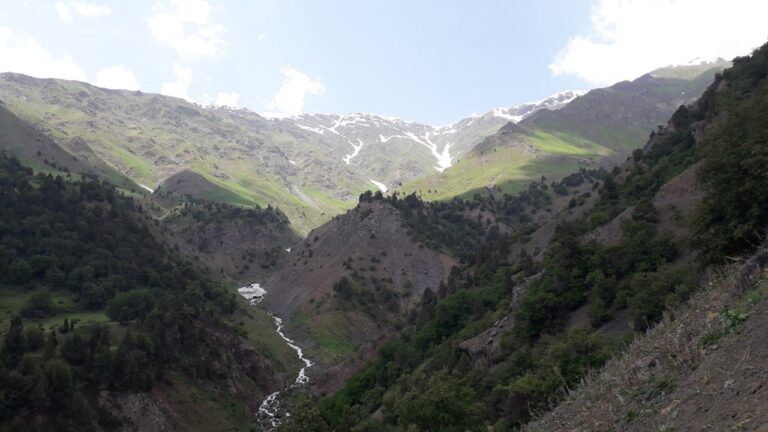
The Pamirs are a traditional tourist region and high altitude mountaineering. There two Pamir tops superbly ascend in the sky: the Peak of Eugenia Korzhenevskaya – 7,105 meters and the Peak of Ismoili Somoni – 7,495 meters. They are tremendously the mainstream with climbers everywhere throughout the world.