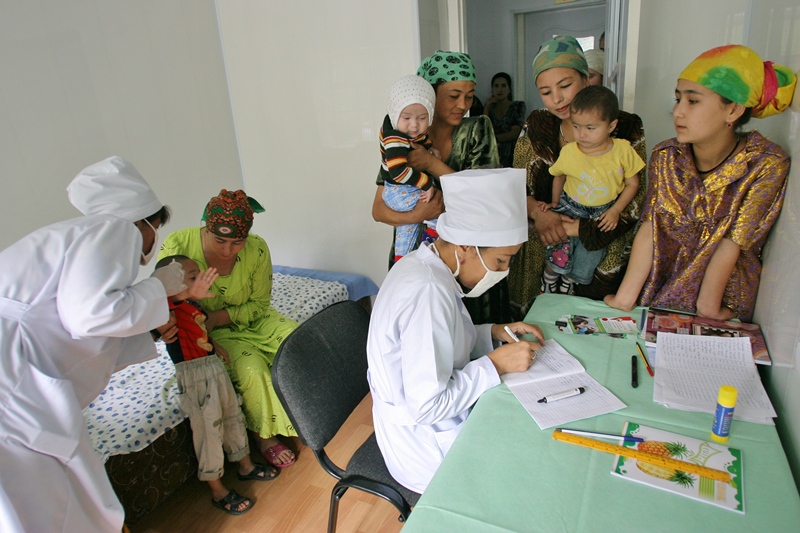
The Asian Development Bank (ADB) has approved a $32 million grant to help the Government of Tajikistan improve healthcare services in three districts of Fayzobod, Rasht, and Shamsiddin-Shohin, according to the AND Tajikistan Resident Mission (TJRM).
“A healthy population is crucial for Tajikistan’s growth and development, but this is only possible if healthcare services, particularly for mothers and children, are of good quality and accessible,” said ADB Senior Health Specialist for Central and West Asia Ms. Rouselle Lavado.
Healthcare coverage in Tajikistan has improved over the last few decades, but it still lags behind global and subregional averages on maternal and child health. The country’s child mortality rates are 20 neonatal and 37 infant deaths per 1,000 live births, compared to the Sustainable Development Goals target of 12 neonatal and 25 infant deaths per 1,000 live births. The maternal mortality rate is also higher in Tajikistan at 32 deaths per 100,000 live births in 2017 than in other Central Asian countries, which average 23 deaths per 100,000 live births.
The Maternal and Child Health Integrated Care Project will help address key issues affecting Tajikistan’s health sector, such as inadequate funding, outdated infrastructure and health facilities, as well as a lack of qualified medical professionals and healthcare providers, especially in rural areas.
The project will also modernize infrastructure and equipment in central district hospitals and rural health centers, and improve health education and behavior in communities. It will support the government’s efforts to establish a national equipment management system.
Total cost of the project, which is expected to be completed in 2025, is $35.2 million, with the Government of Tajikistan providing US$3.2 million.
ADB is celebrating 20 years of development partnership with Tajikistan in 2018. To date, ADB has approved over $1.7 billion in grants, concessional loans, and technical assistance to the country. ADB and Tajikistan’s development partnership, which began in 1998, has restored and built the country’s new transport and energy infrastructure, supported social development, expanded agricultural production, and improved regional cooperation and trade.
ADB is committed to achieving a prosperous, inclusive, resilient, and sustainable Asia and the Pacific, while sustaining its efforts to eradicate extreme poverty. Established in 1966, it is owned by 67 members—48 from the region. In 2017, ADB operations totaled $32.2 billion, including $11.9 billion in cofinancing.