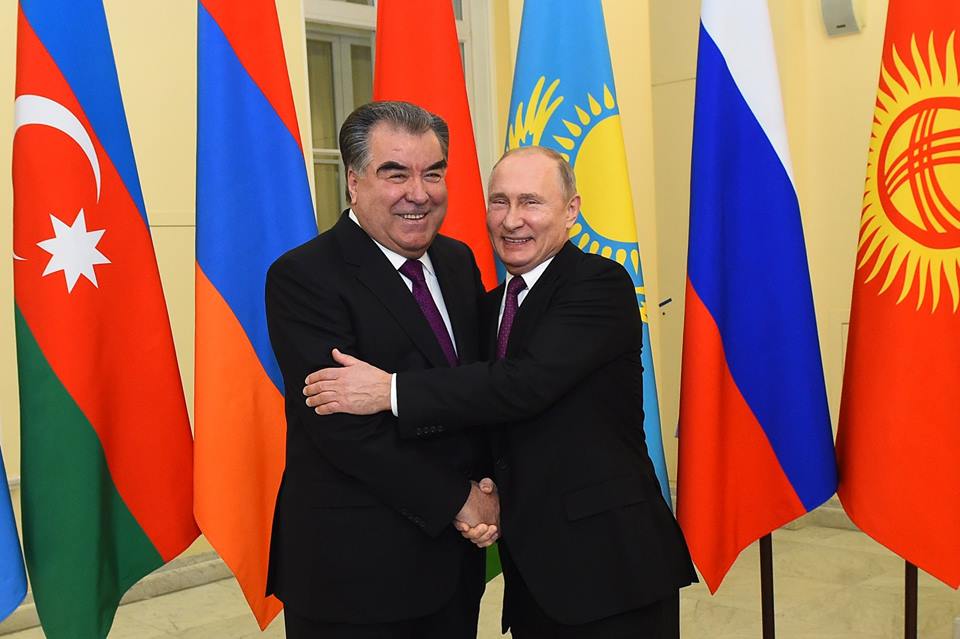
St. Petersburg yesterday hosted an informal summit of heads of state from the Commonwealth of Independent States (CIS).
According to the Kremlin, leaders of the Commonwealth of Independent States have reviewed the results of the past year’s work.
Before the summit, which took place in the form of a lunch on behalf of the Russian President Vladimir Putin, a joint photo session was held.
The meeting reportedly did not have a specific agenda; participants had an informal conversation and discussed various issues.
The summit participants, in particular, discussed the state and prospects of further interstate integration within the framework of the CIS and exchanged views on further working plans related to providing socioeconomic development and strengthening security within the CIS area, according to the Tajik president’s official website.
Established on December 8, 1991 after the dissolution of the Soviet Union, the Commonwealth of Independent States (CIS) is a regional organization. It now consists of Azerbaijan, Armenia, Belarus, Kazakhstan, Kyrgyzstan, Moldova, Russia, Tajikistan, Turkmenistan, Uzbekistan and Ukraine. Georgia pulled out of the organization in 2009.
Although Ukraine was one of the founding countries and ratified the Creation Agreement in December 1991, Ukraine chose not to ratify the CIS Charter as it disagrees with Russia being the only legal successor state to the Soviet Union. Thus it does not regard itself as a member of the CIS. In 1993, Ukraine became an "Associate Member" of CIS. On March 14, 2014, a bill was introduced to Ukraine's parliament to denounce their ratification of the 1991 Agreement Establishing the CIS, following the Russian military intervention in Ukraine and annexation of Crimea, but was never approved. Following the 2014 parliamentary election, a new bill to denounce the CIS agreement was introduced.
In September 2015, the Ukrainian Ministry of Foreign Affairs confirmed Ukraine will continue taking part in CIS “on a selective basis.” Since that month, Ukraine has had no representatives in the CIS Executive Committee building. In April 2018, Ukrainian President Petro Poroshenko indicated that Ukraine would formally leave the CIS. On May 19, 2018, President Poroshenko signed a decree formally ending Ukraine's participation in CIS statutory bodies. However, as of 1 June the CIS secretariat had not received formal notice from Ukraine of its withdrawal from the CIS, a process which will take 1 year following notice being given. Ukraine has stated that intends review its participation in all CIS agreements, and only continue in those that are in its interests.