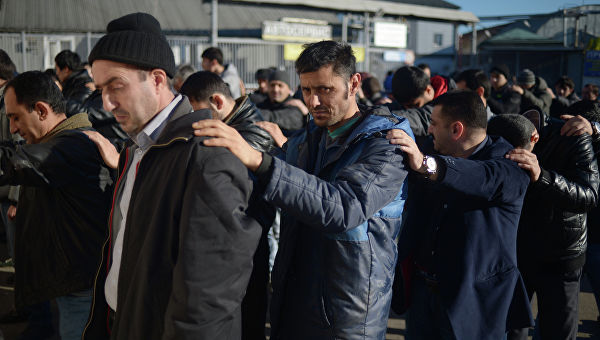
Magnitogorsk police have reportedly launched raids on homes of labor migrants from Central Asia, tightening check of their documents.
Tajik labor migrants tell Asia-Plus by phone about mass detention of labor migrants in Magnitogorsk.
“Police have tightened check of labor migrants’ documents. Several persons have already been placed in detention center,” one of Tajik labor migrants told Asia-Plus by phone.
According to him, nobody explains the cause of such tightened checks and raids. “There are rumors that according to one of versions of the law enforcement authorities, the apartment building blast was a terrorist act that was organized by a Central Asian,” the migrant said.
Meanwhile, Russian investigators deny that the deadly building blast was caused by explosives but insisted they are considering “all possible causes.”
Russia’s Investigative Committee has said that no traces of explosives were found in the rubble of a residential building that was partially destroyed by a powerful blast on New Year’s Eve.
An apartment block in Magnitogorsk, Chelyabinsk Oblast, Russia, partially collapsed on December 31, 2018, at approximately 6:02 a.m. local time. The cause of the collapse is believed to have been a gas explosion. The 10-story high-rise apartment block, built in 1973, was home to 120 people, and 48 flats collapsed in the blast.
Citing emergencies officials, Russian media reports said after the completion of the rescue operations on January 3 that the blast killed at least 39 people and injured 17 others.
Recall, twenty-four-year-old Rajambo Isoyeva and her three children – 6-year-old Ahmad, 4-year-old Fotima, and 3-year-old Muhammad — were among those who died in the collapse of the apartment building.
The family's father, Shuhrat Ulfatov, 26, survived and is recovering. He is currently in a hospital in the city of Chelyabinsk after spending more than six hours under the debris.
The bodies of Isoyeva and her three children were brought to Tajikistan from Russia late in the evening on January 6 and were buried at cemetery in the village of Malik Giyoyev in Kushoniyon district in Khatlon province in the morning on January 7.