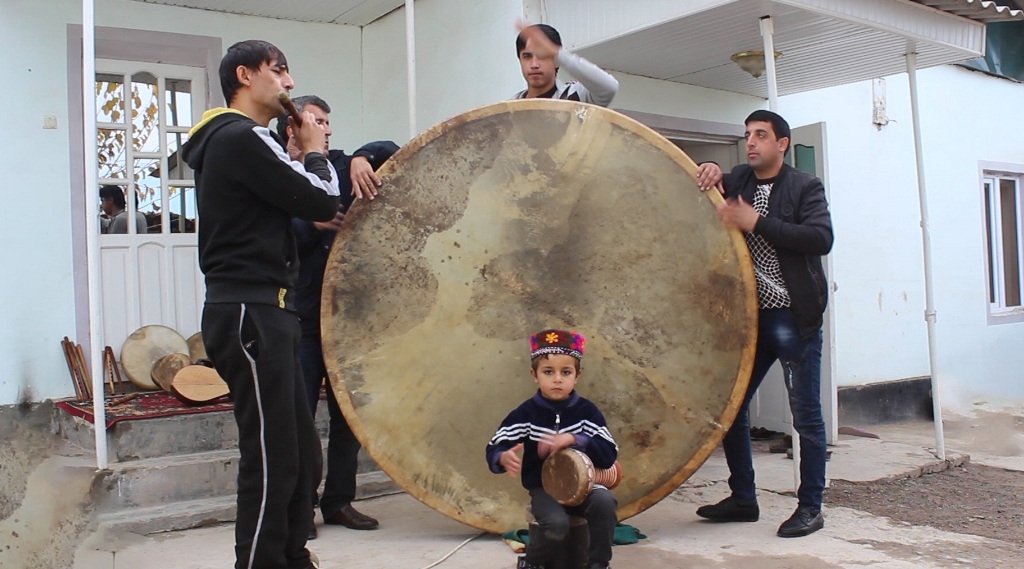
A 30-year-old musical instrument master from Kulob (Khatlon province) plans to get listed in Guinness World Record. Saidnodir Haidarov has built a doyra weighing 34 kilograms and 1.7 meters in diameter.
Haidarov has reportedly worked nearly 100 days to build the world’s biggest doyra.
A doyra (or dayereh) is a medium-sized frame drum with jingles, used to accompany both popular and classical music in Central Asia’s countries, Afghanistan, Iran, Turkey, the Caucasus and the Balkans. This is a single headed percussion instrument which is not only found in Northern South Asia, Central Asia, and the Middle East, but also in parts of the Russian Polar regions.
The simple drum is formed by attaching a skin cover onto a wooden ring with glue and cloth ties. Some doyra have metal pieces attached to give them a tambourine-like quality.
The history of doyra goes back to many centuries. An engraved bronze cup from Lorestan at the National Museum of Iran in Tehran, portrays a double ney (end-blown reed pipes), chang (harp), and dayereh in a shrine or court processional, as similarly documented in Egypt, Elam, and the Persian province of Babylonia where music was arranged for performance by large orchestral ensembles.
The jingles which are thin metal plates or rings, are attached to hooks in three or four rectangular holes in the circular wooden frame. The drumhead is made of goat skin.
The sound is produced by hitting the membrane with either hand – the left hand, which also holds the doyra, strikes the edges, and the right hand strikes the center. The right-hand fingers are fastened about their neighbors and suddenly released (like the action of finger-snapping) to produce loud, rapid, sharp sounds.
The doyra is a solo instrument. Most often it is supported by ghijak (a stringed instrument played with a bow). The doyra is most often used for keeping the rhythm in folk songs and dances, and also in traditional rituals, like wedding ceremony.